Default and Deviant Wisdom

People cannot be trusted on how to live your life. In his poem “The Laughing Heart”, Charles Bukowski warns:
your life is your life
don’t let it be clubbed into dank submission.
be on the watch
there are ways out
there is light somewhere
it may not be much light but
it beats the darkness
the gods will offer you chances
know them
take them
you can’t beat death but
you can beat death in life sometimes
and the more often you learn to do it,
the more light there will be
your life is your life
know it while you have it
you are marvelous
the gods wait to delight
in you.
Maybe you dislike that, I don’t know. Maybe not because in our times so much of it sounds so cheesy. Maybe it is because you want some hack from a guru who sees you through the screen and tells you what to do: something special, meant for you specifically. Anyway and of course, we all find all the enduring but generic wisdom boring. A catechism of true clichés.

These in fact are solid. Banality is the veil of general truth. You’ve known for years to lift weights and guard your tongue. But until these clichés etch themselves into you, they’re merely your cognitive lint, something you know but do not live. Preachers of important truisms exist not to innovate but rather to rehearse them to you.
Again, the truisms are solid, applicable to most. Anything of rare genius or courage dies in transmission. The self-help industrial complex (of which ZHPL is not a part) thrives on things that are applicable to most, such as those above, or on things applicable to few and misapplied to many more, such as: cold showers at 5 am, 18-hour intermittent fasting, digital nomadism, trying psychedelics, polyamorous relationships, having no kids, going trans or asexual, radical carnivore diets, living entirely off-grid, or chasing highly paid corporate career. Billionaire gurus and influencer shamans peddle sane or insane but mostly recycled axioms and wrap them in neon jargon. They are your mind-hackers, parasites feeding on you, often on your hunger for simplicity in an age of complexity. They reduce your life to reasonable or silly bullet points, a prefabricated flowchart. Also ideologies, religions, and lifestyle may be further memetic vampires, hijacking your yearning for meaning to replicate themselves. So the moment you ascend beyond generic advice, wise or foolish, the terrain turns weird. The most transformative advice for you may in fact be pathological for others. What saves your soul might cripple another’s. Even some though not all ancient truths may at times be bad for you. This is also why a “wise” man may always come and justify whatever you do. His Wisdom™ is a sophistic Swiss Army knife, equally capable of praising your risks (“Fortune favors the bold!”) and pathologizing them (“Don’t spit into the wind”).
Justin Murphy notes how even generally excellent advice may be at least suboptimal for you.
Good advice for the general population is guaranteed to not be exceptional advice for you. The most positively life-transforming advice for you must be something that is technically unhealthy on some metrics, but explosively effective on one or two others, in accord with your unique personal taste and vision. … So “doing all the right things” in health and lifestyle is extremely low alpha. Alcohol is a great example. On one level, it’s an obvious, unambiguous negative, a rationally indefensible poison. But there are countless positive effects that can be extracted from alcohol, assuming you have the spirit to carry them through. Think Churchill, or Hunter S. Thompson. … Maybe you should do cocaine all day, every day, and just write fire tweets nonstop; then come down every night with a few beers—never work out, eat only one big bowl of pasta every day—maybe that could be truly amazing advice for someone reading this right now. It would not be good advice in general, but that’s my point: Good advice for the general population is guaranteed to not be exceptional advice for you.

Compare ZHPL’s sci-fi story “Don’t Make Me Think” (2022), full of emojis.
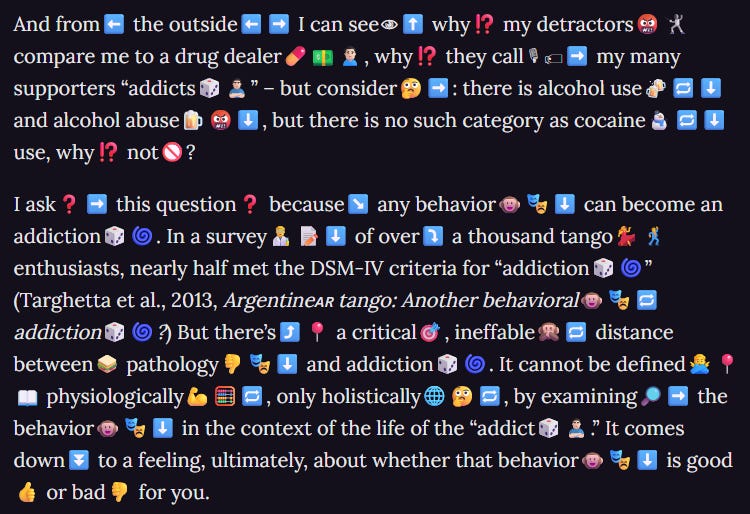
Likewise Nietzsche in Gay Science, Bk. 3 §120.
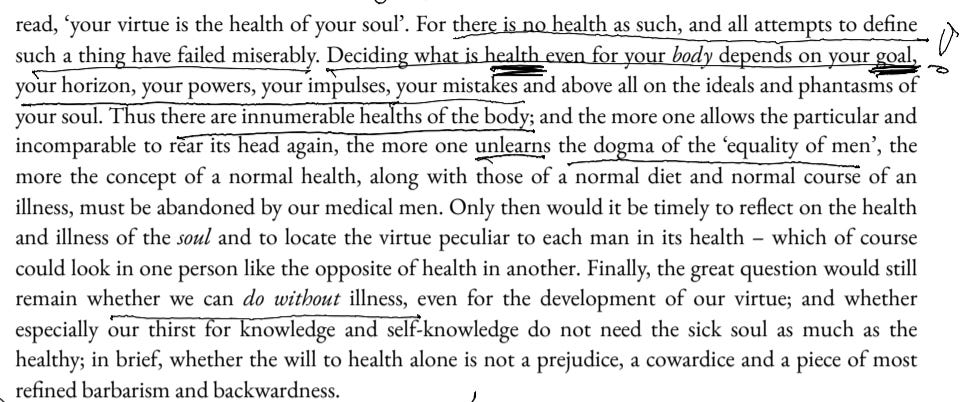
Nietzschean self-overcoming, monastic asceticism, and radical hedonism are similarly high-risk paths, feasible only under certain conditions. To recognize them requires decent self-knowledge, or if you’re lucky, a mentor or friend who knows you well. Parasocial content creators will only offer counterfeit intimacy. So barring evidence or real desire of the contrary, embrace the default. Lift, save, love, forgive and never forget. Yet, custom-build your own deviant patches. Then tread fearlessly but carefully. It will be mostly a solo raid. No community, no guru, no ancient text that maps your particular inferno. What works for you might be poison for your fiend. Including your epic goals. Remember what hoe_math said:
Whenever someone is telling you what (or who) you must value, you found the bad guy. No one gets to tell you what “matters.” That’s up to you. No one gets to say “You like the beach as much as you like the mountains.” No one gets to say “You like pizza and steak equally.” No one gets to tell you WHO you like, either. … When people tell you that what you want doesn’t matter, but what they want does, you’re talking to someone who hates you and is actively trying to harm you as much as possible.

(Note: He is not talking ethics here but what you like or desire. He does not say you may do whatever you like even if it is heinous, like burning kittens for fun, as some Chinese pervs do. He just says, don’t let others tell you what you like and desire, and don’t let them say it doesn’t matter. It does.)
Not saying you are to do drugs. I am saying that obsession with optimization and health is a form of fear. Many achieve everything the manual told them to achieve, then realize the manual was written for people with small souls. Stop being “good”. Find your specific “pathology” and leverage it. (I am tired of all these weakling quotations marks, from now on let’s reduce them.)
How can I help
I work with various people, including those who are successful by normie standards but feel like they are losing their minds.
My philosophical consulting helps them in this:
Identify the deviant advantage: the obsessive, weird, or unbalanced thing one should do.
Kill the zombie: cut the sensible but draining obligations.
Design and pursue an epic goal: move from maintenance (keeping the status) to adventure.
Yet do not destroy oneself.
If you are tired of life, let’s talk. More here, including my email.