

Here is my email interview with J. Sanilac, an anon composer and writer of fiction and non-fiction; to me esp. a sharp analyzer of attractiveness, romantic love, architecture, rationality, religion, metaphysics, AI, and much else.

His essays have been censored and suppressed hard by mobs, algos, and NGOs. Study that closely.
Read the introduction and conclusion to his non-fiction, and the guide to his art. Listen to his music.
We did the interview in August and September 2026. I added pics and links.
Topics we discussed: simps, incels and black knights VS laws of attraction; AI companions VS real sex and intimacy; Bronze Age epicness VS daily depth; Sanilac’s pragmatic, four-realm religion VS other religions; impersonal incentives VS evil elites behind global economic collapse.
Originally, we’d planned to do a moderated email discussion between Sanilac and Zero HP Lovecraft (my previous interviewee), but Zero was too busy, so we dropped the plan. Zero might react to this interview later.
BP: Let me start with the issue of male-female relationshits [1, 2]. Excuse the word please, I can’t help it. Could you summarize your take here?
And maybe also how it differs from Zero’s, which seems to be the following:
The word “incel” is poorly conceived because sex is not actually what these men involuntarily lack. Sex can easily be bought. They crave for companionship and the unfeigned affection of a woman. However, many men today succumb to a self-pitying blackpill incelish (self)talk and hide behind their cynicism of burned-out manwhores as a shield to avoid trials of the mating market. This is esp. acute among higher-IQ men whose reason alienates them from their lizard brains. As for the institution of family, tech like washing machines and birth control pills have dismantled it and left normies with the expectation that fathers should just be penis-having moms, hence the situation of two moms raising children where one happens to be male. This stifles the fathers’ power and deprives their sons of manly ambitions.
Yet, on a deep level, genuine incels are heroes. In a manner akin to the Buddhist idea that one is already enlightened and only needs to realize it, they are already on a heroic plane because they have resisted sex and not committed the sin of having sex (if any man have ears to hear, let him hear). Because, consider: men (and not just men) are biologically built to believe fitness-enhancing, rosy lies about women. Otherwise, they would never suffer them. Yet, men desperately need women to obtain, esp. during sex, a transient relief from the doom that crushes them almost non-stop. Naturally, and as it should be, most men give in. But seldom do they realize that the key to success with women is to not need them, however that may seem to contradict the previous sentence.
So, men, stop writing heartfelt apologetics online about why it’s so impossible to get a good girlfriend. Read the classic Western novel Lonesome Dove (1985) to understand a man who is a rock unto himself. Put it into practice by swearing off women. Once they sense your lack of need, they will gravitate toward you. Many a man can reach that state, even if he is short, chubby, or ugly, provided he develops that internal character and takes a bath. Also stop being the penis-having mom, that might give your life some meaning.
Women, if you can (you can’t), let us men stop sexual emancipation run wild within you. Stop domesticating your husbands. Realize that even if you invest your time in keeping the home (too often you don’t), the tech that men have invented has left you with a rather dangerous surplus of free time esp. once the children are grown, and idle hands do the devil’s work. Also, admit you are not evolved to handle the tsunami of online worship a.k.a. likes, and welcome our shaming to keep you anchored in reality.

[Pic from Sanilac’s podcast at Spotify.]
JS: My work on relationships [1, 2, 3] starts from a very simple observation. Physical appearance and physical mechanics are important and even central elements of sex and attraction. So if we identify the relevant physical factors and improve them, we can improve relationships as well. This is quite obvious, of course, but human psychology makes it hard to implement. Men routinely lie about what they want and what they like, women have big egos that get in the way of recognizing reality, and the public square is more noise than signal. My articles on the topic work past these obstacles to give frank advice with practical value, mainly but not solely to women.
This summary makes me sound very unoriginal. Many other writers claim to do the same. However, the devil is in the details. Instead of repeating the comfortable lies people want to hear, I’ve demonstrated uncomfortable truths with unusual thoroughness. I’ll offer a few examples.
When it comes to breast size, bigger is better due to supply and demand; recent technical advances have made augmentation surgery more effective than people realize, and women should default to exploiting it to the extent possible. Beige lingerie is ugly, and contrary to popular conviction, there is no practical need to wear it; in contrast, thigh-highs boost attractiveness significantly, and they should be standard, almost everyday clothing for women. Monogamous relationships give women much more sexual pleasure than men, and this imbalance is best corrected with frequent fellatio. Even so, young men are ignorant about basic sexual techniques they could easily learn with blunter instruction (which I won’t detail here — sorry boys). And so forth. There is much more in “Dispelling Beauty Lies.”
Some of these recommendations seem to be shocking, others not; in either case, I provide a great deal of evidence to support them. Yes, they are true — on average. But preferences often fall into a rough 80:20 ratio, leaving plenty of completely honest dissenters. If you want more statistical nuance, you’ll have to read my writing, as it would be too clunky to pepper this interview with qualifications.
Again, it’s all rather simple. But that’s part of the charm. While so much of romance remains an incalculable mystery, simplicity makes many physical and mechanical elements of relationships knowable and tractable. They’re levers we can actually get a grip on. And it should go without saying that when a small number of modifiable parameters have a large and consistent effect size, they ought to be the first targets for intervention. People aren’t used to hearing attractiveness discussed in these terms, so I do my best to give a friendly, children’s-book presentation on my website. But this is the essence of the argument.
Beyond physical elements, I also address seduction, and most notably a set of delusions clustered around what I call the illusion of dominance. In brief, women have turned the sexual dynamics of relationships into an elaborate dominance theater with little connection to reality. In recent years it has gotten exceptionally bad, because a large fraction of women have grown up on violent pornography, which has had an escalating effect. This demand for dominance theater, as well as the many misperceptions attending the illusion of dominance, make women less appealing and relationships less rewarding for men. Yet men keep playing along uncomplainingly — partly out of wimpy desperation, and partly because they’ve been confused by false accounts of what their own desires are “supposed to be,” but aren’t. I call these sorry figures black knights.
Aggressive indifference is a particularly damaging attitude downstream from the illusion of dominance, and a widespread social contagion today. Aggressively indifferent women avoid doing easy things that appeal to men, and even intentionally do the reverse to prove how little they care, as if not caring were some kind of moral victory. The result is an anti-seductive aura that suppresses genuine male affection, leaving everyone involved worse off. In “The Illusion of Dominance,” I take pains to expose the delusions and confusions behind these attitudes and explain how we can collectively move past them.
The above is very incomplete, but still more than enough summary of my views on relationships for an interview. My next remarks will respond to the account of Zero’s ideas you’ve provided above, which I’ll assume accurately represent his views, as I haven’t read his work directly.
I agree with Zero that incel circles online seem prone to encouraging each others’ feelings of hopelessness, and that this does them more harm than good. I agree that a more proactive and less weepy approach will get them better results, and that it’s important to care less deeply about winning women’s affections — partly because desperation makes you less desirable, partly as a corrective to the doom loop, and partly because there’s more to life. (Note that this does not contradict my previous criticism of aggressive indifference in women, because neither the situation nor the sexes are the same — as I’ve explained at length in my work.) I also agree with Zero that Mr. Mom is a lifestyle few truly find appealing. Finally, Zero appears to recommend Westerns as helpful models for male behavior. I have independently made similar recommendations myself, though I usually suggest movies from the 30s and 40s first. Thus, we appear to share a fair amount of common ground.
That said, “swearing off women” is not something I would overly encourage — at least not for an extended time. Even a cursory study of women’s fantasies makes it plain that sexually successful men are more desirable, men with a high sex drive are more desirable, and abstinent adult males are… normally not in the picture at all. “Swearing off women” is probably a useful temporary reset that helps pull a struggling incel out of spiraling negativity. But for those who do intend to form relationships in the future — and the large majority can — it seems unwise to give it a prominent place in your identity, because doing so may eventually make your path more challenging than it needs to be. Without saying this recommendation attributed to Zero is useless — I assume he provides appropriate context and qualification elsewhere — I advise caution.
According to your summary, Zero sometimes reflects on relationships and sex through a philosophical lens having to do with feelings of existential doom, enlightenment, and even heroism. This is a perspective I don’t really share. Certainly, the joy a good relationship brings can be revelatory, and enable one to see existence in a more beautiful light, which can have spiritual value. Love has intrinsic value as well. Despite this, I prefer to analyze romantic and sexual relationships in a down-to-earth fashion whenever possible, because I believe it’s healthier and more productive.
Relationships are unpredictable, and at present the best are exceedingly rare, so lofty expectations lead quite reliably to disappointment. The grounded approach is to simply view them as an important source of happiness and a component of the good life, which some people have better access to than others, often for easily identifiable reasons. From there we can take practical steps to help more people have better access and increase the baseline return, without getting lost in dramas that end up generating distress on net — and, crucially, without limiting the upside to any significant degree. Whereas one who waxes philosophical about romance, or sex for that matter, risks failing to enjoy the zinnias already in the sun while questing in vain for a peony from the mists of Shangri-La that one can’t happen upon by any reliable means.
In short, I believe the philosophical and even mystical side of relationships and sex is real and valuable — but that we nevertheless get better outcomes when we start by demystifying them. This is congruent with my broader standpoint of pragmatic idealism. Now, to be clear, I doubt my remarks here respond to Zero’s views with much precision, and I wouldn’t want them to be read in that spirit; but they do, at least, evince a different approach.
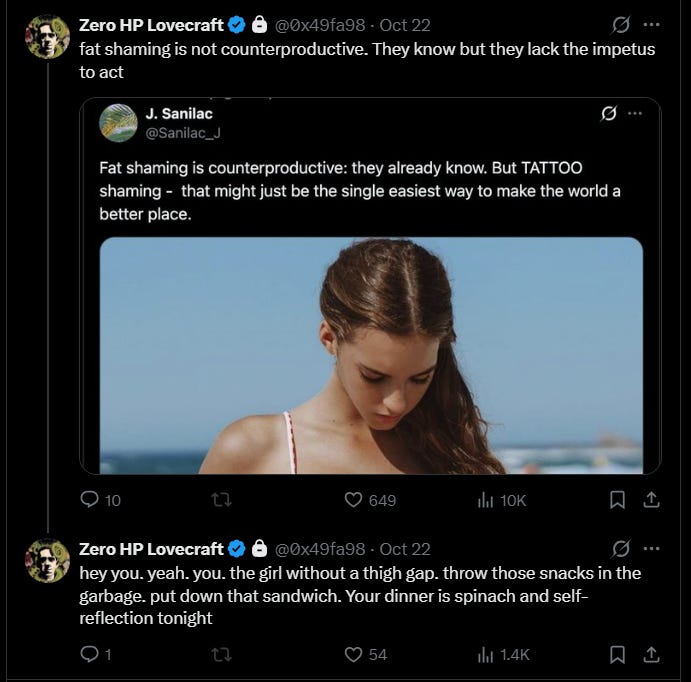
Zero seems to be of the opinion that women’s egos have been overinflated by modern society, and that cruel remarks regarding women’s appearance may help to reverse this. I agree completely on the first point, but I don’t agree on the second. I believe frankly cruel remarks about a woman’s appearance are unhelpful even when true, and distinctly harmful when exaggerated or invented for effect, so that one does better to communicate the truth tactfully and at an appropriate time. And I observe more broadly that deepening the rift between men and women — which is, when judged by political polling, still considerably smaller than many believe — endangers our nations, and even our civilization, because it weakens the solidarity we need to protect ourselves from clear and present dangers. And, naturally, it impairs our ability to form families.
That said, I feel obliged to reflect honestly. The vast majority of women have dismissed my most helpful suggestions even when I’ve presented them as politely and lightly as possible [1, 2] . And communicating with today’s public on its own terms — which, to be blunt, are retarded and base — is something I demonstrably don’t know how to do. So while I have an innate bias against the style of discourse Zero proposes, and it continues to appear counterproductive from my own perspective, I am not in a good position to criticize it. My proposed alternative of patiently reasoning from the best available evidence hasn’t gotten results, and seemingly can’t get results given the current environment and social character. Of course I can still offer true and useful answers transparently and memorably to those who want them. But when it comes to moving the masses in general, and 99% of women in particular, one needs a different style of communication from a different kind of person. Which leaves me at a loss. And having thus voiced my objections, I leave others to experiment in skullduggery as they will. (N.B. To avoid any confusion, “How to Trick Your Girlfriend into Being Hotter” is an essay I only collated, precisely as described therein, without inventing or approving of the proposed techniques myself.)

[Prominent pic from Sanilac’s website.]
BP: Is long-form writing — including yours — outdated, maybe esp. due to AI? (As suggested by Zero, in my interview, even about his own writing.)
And regardless, what might work in persuading the public to adopt your ideas?
JS: AI certainly threatens the market for long-form writing in numerous ways. Nevertheless, you cannot arbitrarily size a work without loss. Some ideas simply require more words to explain; if you take words out, you cannot explain them properly. So I do not see ripping those ideas up into pieces and representing them in meme form as a serious alternative.
Riling people up with brief, emotive social media posts degrades discourse, often without communicating the necessary. And it degenerates into writing slogans for the mob inspired by other slogans for the mob. Dumb ideas win out consistently. By consequence, those dumb ideas gain social currency, and the social currency creates an illusion they have some legitimacy or substance, when they have neither. [BP: Compare Sanilac’s Daily Journal, August 7, 2026.] It’s no way to advance understanding. In the end I just find it all very uninteresting.
As for the other question, I am not a person who has any idea how to sell anything to today’s public. Frankly, they seem to me like a gang of base retards, and beyond that, I have no intuition for what moves them. My hope, of course, is that someone out there is not retarded and base, and can still derive value from my works. But the number of such people is disappointingly small.
By consequence, if my ideas are ever to influence the broader public, then someone other than me must transmit them. Namely, by propagandizing the public in ways that would never occur to me, and which I would refuse to carry out even if they did occur to me. I say this not out of the elitism that a reader unfamiliar with the background facts will surely assume at first glance, but rather after having made years of arduous attempts at communicating to the best of my ability, all of which came, sadly, to nothing.
To put this pair of responses together: the public is base, retarded, and largely moved by propaganda and trends, but that doesn’t mean that pandering to base, retarded people who are largely moved by propaganda and trends can advance genuine understanding or judge true value. So, there need to be two levels of discourse. One level that involves advancing understanding and judging true value, and a separate level that involves herding the biomass. That second job is not for me.
BP: Understood. But, speaking at an individual (not societal) level, where does a man even start to look for a woman suitable for your vision of a relationship — or, God forbid, even for marriage?
JS: I do not have any helpful advice here. The fraction of women who are worth the trouble today is much smaller than one would wish, and I don’t see how anyone can change that fast enough to matter. When prices go up and yields go down, the rational response is to invest less. The fact that one was initially overenthusiastic about the security in question doesn’t change that.
BP: Then let us move to AI, its progress, and meaning. You write about that in your essays “Ailom” (AI-induced loss of meaning) and “Ultrahumanism.” What are some of your chief points there?
JS: At the time of this interview it’s hard to know exactly what capabilities AI will have in ten or twenty years, let alone a hundred. I can make guesses as well as the next person (as a central case, I predict AI will accelerate certain branches of scientific discovery without developing broad superintelligence anytime soon), but I don’t assign them high confidence. Instead I prefer to focus on a different cluster of questions we can weigh from firmer ground. Namely, how will the likely and possible advances in AI affect human relationships, and what it means to be human in general?
As I observe in those two essays, AI does not need to reach human-level intelligence in every domain, let alone superintelligence, to create serious challenges for human relationships and society. I cite two important cases.
First, the level of mimicry AI has already attained will allow it to flood the world with slop that is indistinguishable from human output on casual inspection. By consequence, all mediated communication will become suspect, and the kind of decentralized discovery by which humans have heretofore found other humans on the Internet will break down, or at least operate at far lower efficiency. Obviously, this is happening as we speak. It is just an extension of the dead-internet theory. But the extension of dead-internet theory is more consequential than it first seems, because a similar effect will apply across all the arts and letters — even offline.
Second, AI will be able to simulate human friends and lovers in audiovisual format within the next decade. Again, it does not need to reach perfect simulation to change society. Even an imperfect simulation will serve as a cheap substitute that puts downward pressure on the formation of real relationships. This is one reason I’ve been concerned to point out simple but neglected ways we can improve our relationships, and cited the prospect of AI companions from the earliest beginnings of my writing on feminine beauty in 2020.
So, very predictable AI advances threaten to weaken social bonds in very predictable ways, and inhibit their formation in the first place as well. This is a problem we can understand and plan for and find ways to mitigate if we put our minds to it; but because the prospect of superintelligence magnetically attracts all attention, few are bothering to think it through. That is where I hope to have made a useful contribution.

[Cover of Sanilac’s music album Custom Angel.]
BP: Could you please recap what you suggest to do about that?
I suppose it chiefly consists in the following, but maybe you’d like to add or highlight something, or provide context (without which it might sound comically random).
Women,
Abandon passive-aggressive indifference to what men desire from you.
Voluntarily offer spontaneous, frequent fellatio. Initiate sex roughly one-third of the time. Express sexual desire by seductive begging; don’t expect men to guess. Don’t rely on BDSM dominance more or less forced by you on men (who mostly aren’t very much into it).
Treat your beauty as an athletic skill. Optimize weight, hair, and hourglass proportions. Periodically vary clothing, costumes, and accessories (such as thigh-highs and chokers) to simulate variety and outcompete digital avatars.
Men,
Maintain internal self-sufficiency (“needing her, but not needing her”). Reject both simping and the fake dominance of black knights.
Induce her orgasms during intercourse by using postures where your pubic mound rubs directly against her clitoral area. Don’t rely on penetration.
Both sexes,
Abstain from digital wireheading, violent pornography, and AI companions.
Form voluntary, endogamous households or even micro-communities to preserve biological humanity, physical health, and real-world relationships.
JS: I’m continually perplexed by how hard it is for people to understand and accept very obvious and straightforward proposals for improving relationships. People behave as if they are victims of some type of brainwashing or hypnosis, and their minds shut down. Consider the following extremely simple argument.
The data shows men find trait x to be most attractive at value k. The effect-size is significant. Here are easy ways women can set x=k.
Now, it’s extremely obvious that everyone ends up happier if women just set x=k and call it a day. But what happens instead is that men say, “Oh, we don’t actually find x=k attractive, it just happens to look exactly that way in the data — you’re going to sleep with us now that we pretended you were ideal, right?” and women say, “Oh, we aren’t interested in setting x=k no matter how easy it is, because we would first have to bruise our vanity by admitting our current x value is less than ideal; plus, we don’t want to do things men like in the first place, because ideology has convinced us that’s low status, and in fact morally wrong.” Then, to paper over these manifest failures of character, there follow many statistically illiterate arguments about why setting x=k couldn’t possibly be the right answer in the first place because NAXALT, etc. To any reasonable observer their responses are absurd, and indeed embarrassing. But as I said, most people are like hypnotized zombies, and when it comes to this topic their brains shut down and they can’t recognize the obvious to save their lives.
While this sorry outcome would be regrettable in any day and age, today advancing technology is making relationship substitutes better and better. Instagram girls, OnlyFans girls, imaginary women, and soon AI companions keep optimizing x, y, and z to become more and more convincingly desirable, and nearly all other women keep not optimizing x, y, and z no matter how easy it would be — sometimes even doing the opposite on purpose. So we are gradually descending from a situation that’s needlessly sad to a situation that’s needlessly sad and blocks the formation of basic social bonds, producing an unprecedented level of atomization. (To repeat: substitutes do not need to meet the standard of full replacements to create downward pressure on the real thing.)
The worst side-effects of these technological advances would be avoidable if people just stopped, or even momentarily took a break from, being retarded zombies (tall order, I know), and implemented the straightforward solutions I’ve already laid out, in very practical terms, in my various articles on attractiveness and seduction. Unfortunately, “People can stay retarded longer than you can stay alive” — to quote Keynes. I don’t see a need to go over the specific recommendations here. You mention some of them sound odd when presented out of context. Well, this is evidence that widespread preconceptions are wrong and there are easy gains to be made — not that the recommendations are incorrect.
Let me add that it is legitimate to worry about the consequences of machine superintelligence. I believe the imminence of this risk has been intentionally exaggerated by AI companies for financial reasons [BP: compare 1, 2], but I don’t dismiss it entirely, and nobody really knows the timeline for sure. Unfortunately, the attention-getting prospect of a malign superintelligence is causing people to overlook other risks that are more mundane — and also likelier to eventuate. Namely, atomization and weakening of social bonds, downstream of AI mimicry deployed cheaply at scale, as I have just described (AR and VR will eventually matter as well). With everyone watching the sky for an extinction-level asteroid, we have no fire department, and our homes are built out of sticks instead of stones. Why not use some common sense here?
BP: Now more on AI and meaning. Nick Bostrom argues in Deep Utopia (2024) that when superintelligence renders all human labor redundant, humans can preserve meaning through artificial purpose — deliberately imposing constraints on ourselves (like playing golf or going rock-climbing without high-tech gear) or setting up game preserves where AI deliberately holds back so humans can feel impact.
Is this a solution? Or is it a self-delusional cope that succumbs to Ailom?
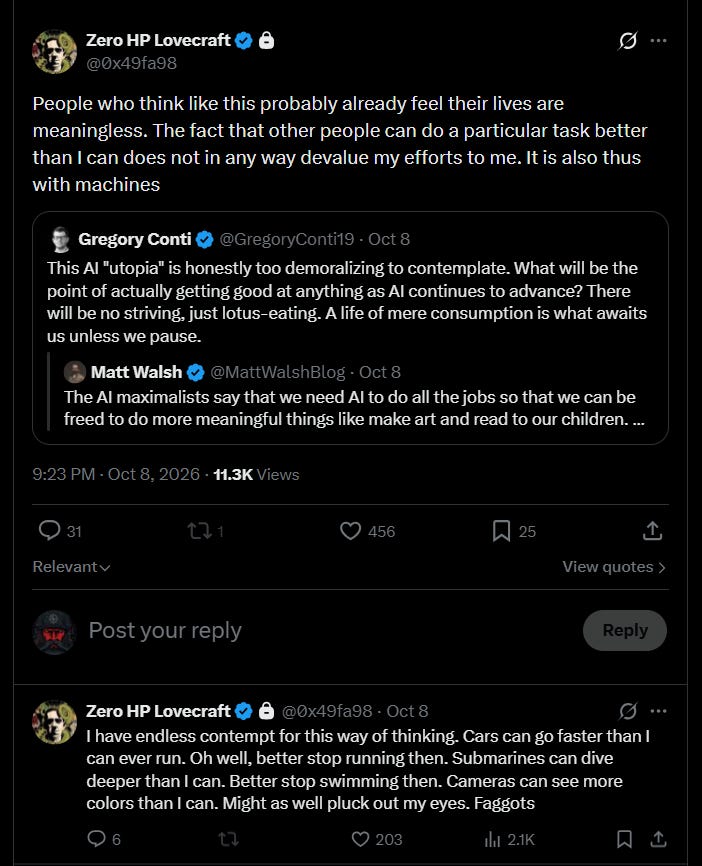
Also, something related: I see it as a huge, although quite specific and far from universal problem, that competent outliers find it hard today (and maybe much more so in the heavily AI-shaped near future) to spot overarching, dominant life goals that would seem to them both (viscerally) attractive — epic, even — yet achievable, or at least worth pursuing despite the odds.
The Boredom of the Gods
Even Andrew Tate is lost (edit from Sept 2026: link dead). It is empty up there even at and in Top G. At least as I heard in July 2025.
What would you advise to such outliers? (If anything at all.)
JS: Firstly, I do not see human purpose in a proposed age of benign AI superintelligence as a difficult problem. It would require some adjusting, that’s all. Certainly many effortful projects would take on a game-like character, but that is not really anything new.
Secondly, you use the word “epic” in a loose sense, but I believe I can add some value by discussing it in a stricter sense as well, even though this may misstate your concerns in certain respects.
Some people feel there is a dearth of worthy life goals today, and that chasing Bronze-Age-style “epicness” might be a solution, or at least a direction. To understand why this feeling arises, and why these proposed solutions usually fail, we need to take several steps back and look at our historical moment from a bird’s eye view.
The underlying problem is a mismatch between the modern economic system and the goals and ways of living we intuitively find meaningful and exciting. Our modern economy amounts to a vast and incredibly complex social machine, wherein each worker functions as a single cog. Not only is the work each individual cog does dull in itself; due to the game theory of large organizations, the rewards one can expect for taking that dull work seriously and executing it to one’s peak capacity are often surprisingly limited — because the gains are diffused through the system invisibly, or because someone in higher management will capture the benefits, or because satisficing suffices. By consequence, most of our energy is consumed by work that doesn’t feel exciting, meaningful, or rewarding. Obviously there are exceptions, like stunt doubles or successful unicorn CEOs. But the exceptions aren’t accessible to many people, so they don’t change the main picture.
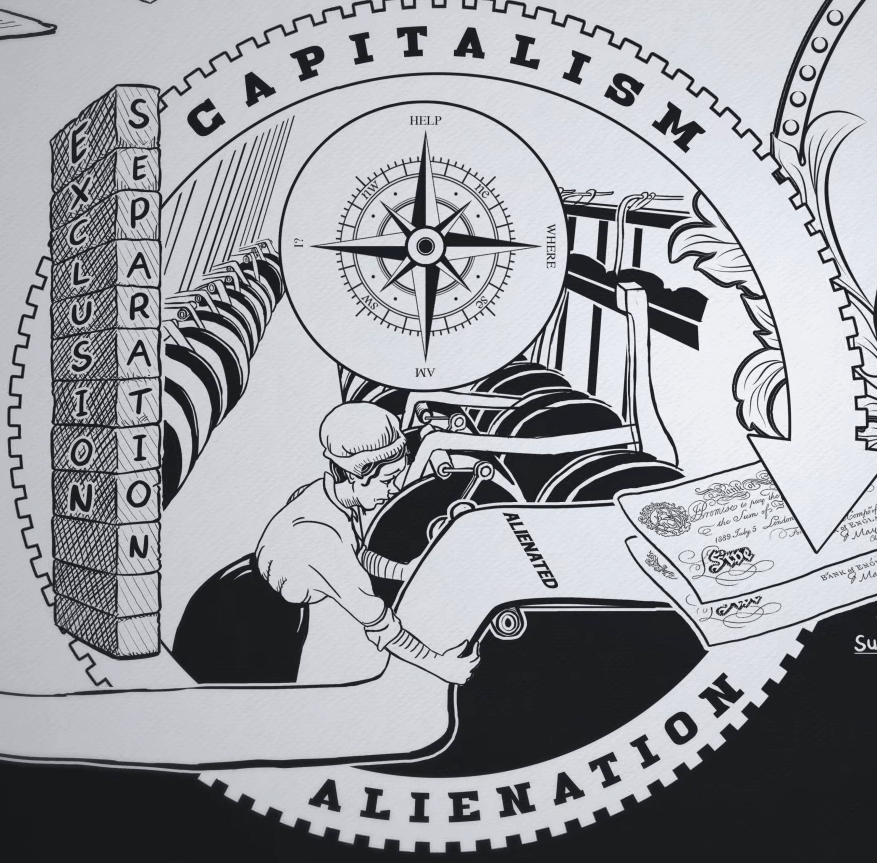
[Marx talks this, yes. No, does not mean Sanilac is Marxist.]
We have this kind of system because it works, roughly the same way mass production works. While the labor itself becomes less rewarding, its material output increases by a large factor. And our system doesn’t just produce higher output in the present. It creates compounding gains in our future prosperity — through technological advances and the practical implementation of those advances. These are important benefits, such that we cannot simply throw away the machine and return to an Eden of noble savages.

[Click on the pic to listen to Justin Murphy on Nick Land on how Earth is captured by technocapital progress. No implication here that Sanilac endorses Land.]
Now, our economic system and its attendant social organization present us with choices that are much different from the choices presented in epic narratives. Homer thematizes the latter explicitly: senescence on a farm, or glory in battle. That either-or might sound like it vaguely encapsulates the human condition across all times, but the word vaguely is doing too much work. The differences are material. In the times whence epics arose there was no economic or scientific progress to speak of, little of the entertainment and infotainment people engage with today, no healthcare, no corporate jobs, usually no running water, and if men didn’t go to war, their stagnant productivity would eventually drop them into the Malthusian trap anyway. This list only scratches the surface.
Because we now have meaningfully different opportunities, when we ask how we can live our best lives, the answers are going to be different too. Bronze-Age-style epic narratives might still sound compelling to us, but that’s because our intuitions for narrative still derive from a bygone age — and sounding compelling and actually making sense are two different things.
Here it becomes helpful to consider some cultural history that’s much more recent than Homer. The urge to beat our modern malaise by reviving epic adventures isn’t new. It was already explored more than a hundred years ago, by T. E. Lawrence, and to some extent Ernst Jünger. Despite their brilliance, those two didn’t come up with any answers that were durable and actionable beyond their own unique circumstances and personalities. Yukio Mishima attempted to repeat their act a couple generations later and failed too, only harder and more dramatically. In light of this history, the Bronze-Age epic revivalism recently popular on social media (complete with Sun-and-Steel’s bodybuilding fixation) is trying to reinvent a wheel already invented decades ago. A square wheel, unfortunately. Because the trail in question turned out to be a dead end, however seductive the accompanying poetry.

[Mishima giving a speech during his attempt at a coup, right before his harakiri.]
Around the same time, the broader thrust of high culture followed a different trail that was more successful, but entailed a sacrifice. Instead of attempting to revive Bronze-Age epic narratives, it deconstructed those narratives to thematize other aspects of human experience — the everyday, improvisatory flow, the sacredness of being. This moment is made explicit in James Joyce, and one might consider his Ulysses (1922) and Lawrence’s Seven Pillars of Wisdom (1926) different responses to a similar problem. Thereafter high culture abandoned epic narratives, and they became the province of commercial novelists and screenwriters, who were happy to use epic styling to build visceral excitement in vitro without concern for whether it had any meaning or application in vivo.
We are the immediate descendants of this cultural history, and we can understand ourselves better if we remember it instead of reinventing square wheels. We immerse ourselves from early youth in ubiquitous and intuitively compelling epic narratives of commercial provenance — your guest Marin Zhelezov cited video games, quite appropriately, but women’s historical romances are in a similar category — which have no direct application in reality; while high culture’s past and present efforts to sacralize other modes of experience sit neglected out of disinterest, not because the idea is wrong in principle, but because abandoning the most engaging narrative forms was precisely the sacrifice made to effectuate it (repurposing them a la Ulysses is not affectively the same even if the same skeletal structure is superficially retained).
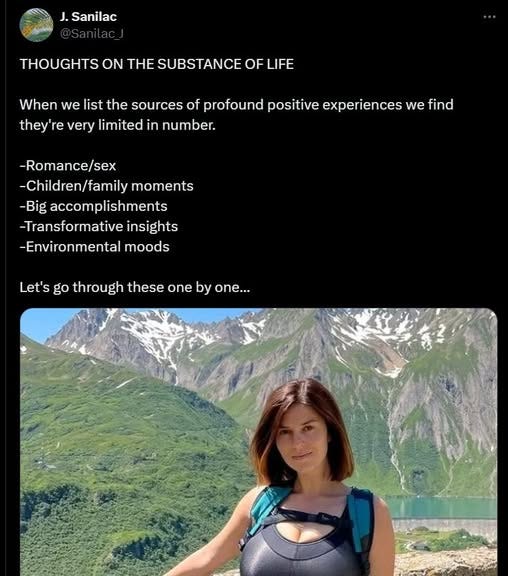
[Defunct tweet. Was good.]
So, to sum up the problem:
The modern world forces inane mental drudgery on us
and presents us with a set of very non-epic choices,
while training our minds on compelling test-tube epic narratives that have no apparent real-world application
instead of alternatives with low entertainment value that do.
This conflict gives rise to deep-seated psychological confusion.
Furthermore, honest attempts by brilliant men to revive epic adventures in the modern world have already been undertaken,
and failed, not just once, but repeatedly.
Presenting the problem well is, I hope, already helpful in itself. But presenting solutions is not something I can do coherently in a few lines in an interview. So, I’ll end this response by pointing toward what I consider the most viable solutions, without pretending to have explained them at the level of detail one would desire.
Enjoy visceral epic narratives, but stop thinking of them as something you enact in the way they’re presented — with sword swinging and exotic, far-flung adventures. Violence and travel are both overrated. Instead, reinterpret the components of epic narratives as affectively rich floating signifiers for a spiritual journey whose external face will look, in practice, entirely different, and normally not “epic” at all. Listen to Anton Bruckner’s creations as a great spiritual adventure that didn’t require he live the life of a conquistador conquering a foreign shore. Similarly, reinterpret your own life as already concealing a quasi-epic significance — Optimalism’s liminal-home meditation is intended as a symbolic protocol for bringing this significance forward so it can be felt.
Search for meaning in depth rather than breadth. There is plenty of room at the bottom, and again, you can learn things from your window that you can’t learn by traveling to Rio. There is depth to be had just from a jog in the park; but to find it by anything more than rare chance, you have to search for it intentionally and intently. You have to put your energy into it. Look at the Pierre Bonnard paintings in Optimalism, for one example. Listen to how easily the imaginative and the everyday sit side by side in Charles Koechlin’s oeuvre, and the small-scale passion in Leoš Janáček’s chamber music. Read Yasunari Kawabata and Masaoka Shiki instead of Yukio Mishima.
Our role as cogs in the modern economic machine entails drudgery few of us can yet be rid off, and there is no scalable short- or even medium-term fix. This drudgery is the main obstacle to living well today, because it saps us of the time and energy necessary to pursue 1 and 2. The long-term answer is to grow total-factor productivity as fast as possible, so the resulting wealth can grant us all the time, energy, and resources we need to pursue the many opportunities life has to offer. In the meantime, don’t blow your money on consumerism. Use it to buy yourself freedom.
This is just the rough sketch of an argument that would need to be an order of magnitude longer to express the details with precision. Even so, I hope I’ve presented my thinking clearly enough that your readers can derive some benefit from it.

[One of the paintings by P. Bonnard.]
BP: This is interesting and important to me. Your advice is reasonable and wise at least for the general population, or even as a backup plan for the outliers who have not given up their hunt for epicness and have not shaken their youthful desires.
A year ago, I posted:
Claim: ordinary life is (a) okayish but (b) not worth living. Even Socrates and Schopenhauer agree on (b). So do many religious people. The strategies vary but go in several and at times compatible types: (1) martyr yourself or do something else heroic (the way of optimistic hazards of saints, missionaries, Don Quijote, Nietzsche, Juenger, Camus, conquerors, explorers, revolutionaries, guerrilas, adrenaline sportsmen, and psychopaths), (2) kill yourself (the way of desperates), (3) wait for death and have hope beyond it (the way of believers; most common, often most tame and inconspicuous, recall Kierkegaard’s Knight of Faith), (4) stop thinking (the way of Schopenhauer and some Eastern people), (5) think real deep (the way of Socrates and Einstein), (6) go intense raw hedonic (the way of rock stars and addicts), (7) go intense subtle hedonic (the way of dedicated artists, psychonauts, occultists, and some Eastern people). I respect most some variations on the 1st way.
Much depends on how we read “ordinary”, but your recommendations seem to be within (5) and (7) — and also some modification of (3) if we take into account your religion of Optimalism. Btw, they remind me of Colin Wilson’s in The Outsider (1956) on moving from existential frustration and restlessness towards aesthetic and phenomenological reframing of ordinary experience. Or this song.
Elsewhere, I have agreed that much of the interest in things like those in (1) comes from epic narratives that we (have) consumed when esp. receptive.
Also, we should distinguish Bronze Age Pervert (few in fact have paid close attention to his book or podcasts) from various kinds of BAPist memetics that have spread online. E.g., BAP is an elitist, like Nietzsche (of whom BAP is a popularizer), so he does not want to advise the masses. Seldom he gives advice even to outliers of his liking, as good, non-trivial life advice is notoriously hard. Still, in his book he says things like: get bodily exercise discipline first, then go carefree but not careless; follow inner mad passion/task; coordinate with good friends; get freedom and power first and foremost (via enough money and strong bonds etc.; e.g. academics today may have the time but lack the rest); jobs, work, and money making are mostly drains and deflectors (being a Tate-like millionaire influencer is still a lame slavish toil, likewise being a bureaucratic dictator as opposed to, say, conquistador); maybe infiltrate CIA and such; expose the regime with lots of satiric but true and cool content; yet don’t make many positive claims about what you believe; maybe run hiking or martials clubs (fe/males separated); win youth for keeping the streets and parks clean, helping old people, claiming public places (e.g. patrolling); maybe have a family but out of lust for the woman (but again, have health and bodily discipline first, then you can give in), and maybe combine that with some of the above.
This by Bull, who seems to be a soldier veteran, goes along similar lines but in greater breadth and detail:

BAP himself says he’s not a soldier (neither wants to run a movement, nor to be a politician). That being said, he is frustrated by the relative scarcity of real and meaningful possibilites to do anything epic like (1) — but also to do anything epic along the lines of (5) (because of bureaucrats and midwits and in his opinion also because of too many olds and women in academia and public life) and (6) (because of feminism, drop of raw passions, and probably also because of the various other factors analyzed by you in your articles).
Mishima, too, was frustrated by similar tendencies. It seems to me he knew in advance that his military attempt at a coup would not succeed, as evidenced by some of his fictions published or written by him beforehand, then played out during his revolutionary performance. That’s different from saying the schtick was a failure as a message, or in terms of remote consequences (hard to tell).
JS: The claim that “an ordinary life is not worth living” is not one I would endorse. I don’t see any reason to take such an extreme position, nor much use in doing so even if it were true. The question that actually makes sense here is just: what’s the best way for me to live?
I have not read BAP in any detail because the pages people have sent me have been uninteresting. Reading your summary of his recommendations, they amount to: “Exercise, follow your passions, make friends, and do some low-level community organizing.” Well, I’m not saying this is bad advice. It’s fine. But it’s hardly revelatory. I think the vivacity of the prose gets people worked up, so they overlook how little is behind it. Eventually fancy language wears off and there’s a Wile E. Coyote moment.
I take a strong stance against Mishima. It’s not that the coup attempt was ever supposed to succeed, it’s that his whole project was a failure. The conclusion of his tetralogy sucks, because his way of thinking was ultimately wrong, and in the end, literary talent couldn’t outweigh that wrongness. Moreover, the regime he had nostalgia for was quite an evil one and didn’t deserve resurrection. He ended his life out of a lingering feeling of inadequacy because he couldn’t join the army and fight a foolish, evil war as a teenager. That’s not admirable or worthy of emulation. It’s sad.
BP: I think here we talk past each other. Let me ask you something else.
In my interview, Zero humorously attacks your ultrahumanist proposal to preserve biological humanity and calls it a demand to be hyper-Amish that leaves humans in a nice little terrarium waiting to be turned into computronium by machinic life. Many transhumanists would argue against Ultrahumanism the same, although Zero attacks them as well, though for other reasons (they are weak or hypocritical moralists who say that humans should gradually leave the space to their post-human successors).
How would you answer the objection that refusing post-human augmentation is eventually a sentimental suicide in a cold, competitive universe? Do you need to refer to your optimalist religion and its warmer view of reality?
JS: My ultrahumanist philosophy proposes a middle way between traditionalism and transhumanism. Namely, that we ought to use technology to become the best humans we can be without making ourselves inhuman. Transhumanist critics respond that this amounts to suicide in a machine-dominated world. I disagree. Their alternative is the one that amounts to suicide. Because if you transform yourself without limit to be maximally competitive in a bizarre future environment where fundamental human inclinations no longer work, you will become so foreign a creature as to be dead. What, I ask, is the point in becoming a superintelligent outer-space cockroach just to say you’re winning, and that you have a better chance of being alive in the year 15,209AD? It’s nonsense.
We should build the brightest future that matches our ideals, not submit to the game theory of an environment that will destroy who we are. We can cure aging, stupidity, and ugliness without becoming inhuman at all. And there, we’re doing far less than we should. We ought to be pushing the necessary technologies as far and fast as we can. Unrestricted transhumanism isn’t just a bad idea in principle. It also scares the plebs away from highly beneficial technological self-improvements that don’t threaten our humanity in any way — rejuvenation technology being the most crucial.
There is no necessary connection between Ultrahumanism and Optimalism. Ultrahumanism is a fully secular ethical philosophy. Optimalism is a rationally deduced religion. Neither depends on the other in any way, and anyone can agree with one and disagree with the other.

[Pic from Sanilac’s “Ultrahumanism.”]
BP: Now I am not sure your ultrahumanist position is that different from Zero’s. He attacks transhumanists similarly as you do, though he might see your Ultrahumanism as not enhancing enough. But we need not discuss that further.
Let’s move to your Optimalism. I will use NotebookLM and some editing to summarize what I see as the chief claims, and some of your reasons for those claims.
Is the summary correct?
Imagine you are trying to learn how to ride a bicycle.
You cannot learn to ride a bike just by sitting in a quiet bedroom, closing your eyes, and imagining it. Your brain is not a supercomputer. It cannot guess how the wind will blow, where the slippery gravel is, or exactly how it feels to lose your balance. To actually learn, you have to get out of your head, get onto a real bike in the real world, wobble, fall down, and try again.
This is why study alone is not enough to grow your soul. You need both a quiet place to think and a messy, real place to practice.
To make this learning process work, the universe is set up like a school with four different rooms.
Room 1: The Blind Classroom — The Lower Realm (Includes Our Physical World)
This is where you are right now. You are born here with amnesia. You don’t remember any past lives. You live a normal, messy, sometimes painful life. You make mistakes, you learn a few lessons, and then you die. Because your memory is wiped between lives, you can’t easily connect the dots while you are here. Your lives feel separate, like single days of school where you forgot the day before.
Room 2: The Quiet Study Hall — The Liminal Realm
When you die, you go to this quiet, safe room to rest. Suddenly, your memory turns back on. You can see all your past lives like a stack of old report cards. You sit down with God — who acts like a kind, helpful teacher — and look at your mistakes. You realize, “Ah, I was too angry in Life 1, and too cowardly in Life 2. I need to practice being brave.” But because this room is completely safe and nothing can hurt you, you can’t actually know you’ve changed here. You need to test your new plan in a real, challenging world.
Room 3: The Driver’s Test — The Middle Realm
Since you can’t carry your memories back down to Room 1 (where the rules say everyone must have a wiped memory), you are born into Room 3. This is a real, tough physical world just like ours, but with one big change: your memory is not wiped. You remember your lessons from the study hall. Now you have to face real-world temptations and hard choices to see if you can finally get it right. Once you pass this final field test, you graduate.
Room 4: The Graduation Party — The Upper Realm (Heaven)
This is a perfect, beautiful place curated by God. Once you have fully learned how to be a good, wise, and complete spirit, you move here to live in joy forever with all other graduates compatible with your acquired character.
Why You Only Need a Few Lives
This school of several lives is designed to get you graduated in a reasonable amount of time.
One life is not enough: If school only lasted a single day, almost everyone would fail. You need a few tries to learn from your mistakes.
Millions of lives is a bad idea: If school lasted for millions of years, you would get exhausted, depressed, and bored. Also, your brain would run out of storage space and start deleting your oldest memories.
The sweet spot: The school is set up so you only need a handful of lives to graduate. Because the timeline is short and achievable, you need not worry about being trapped in an endless loop, and you don’t need any weird cheat codes or escape hatches (arbitrary religious rituals and rules) to get out of school early. You just have to do your homework, pass the test, and go to the party.
Why Believe It
Most religions mostly ask you to accept unproven revelations on authority. Optimalism uses logic and common-sense values (happiness, virtue, personal growth) to work out the above set of beliefs, which produces the maximum net benefit in your present life.
Belief in an omnibenevolent, omnipotent, and omniscient God yields the maximum net good, comfort, and meaning in present life.
It is plausible though not certain that there is a God who permits indeterminacy and conflict so that souls/spirits/minds can co-participate in creation as free (or at least internally random) entities rather than predetermined puppets.
This solves the problem of evil but implies that God must never invervene in the lower realm to stop evil. This in turn mandates real human self-reliance.
Adopting this outlook is a “win-win” rational bet: it aligns utility with basic religious intuitions to grant life meaning and leaves the believer ahead in present well-being regardless of whether the belief is ultimately verified. You don’t have to wait for the afterlife to get a return. Holding these beliefs makes your current life more meaningful, hopeful, and resilient right now — you come out ahead even if the theory turned out to be completely wrong. This is like Blaise Pascal and William James for the 21st century and beyond.
Why Room 1 (the Lower Realm) is Needed
It prevents the overfitting trap (the local maximum).
If you were born into your second physical life with your memories of your first life intact, you would carry all your previous biases, anxieties, and defense mechanisms with you. You would immediately double down on your existing habits to survive, causing you to overfit on your local circumstances.
To prevent this, Room 1 (the lower realm) enforces amnesia. This allows you to live independent, siloed lives. One life you might be a cautious scholar; in another, a daring explorer. Each life is lived with authenticity. Wiping your memory is the way to generate the highly diverse data points your soul needs to escape a local maximum.
Also, in Room 2 (the liminal realm), your task is to integrate, which Optimalism defines as collecting, processing, and compressing the diverse perspectives of your past lifetimes into a higher understanding of your core character.
Moreover, there’s an analogy in machine learning. Room 1 (the lower realm): generates the training data (diverse, forgotten lives). Room 2 (the liminal realm): runs the offline training phase, where the data are compressed and their weights adjusted without real-world noise. Room 3 (the middle realm): acts as field-testing phase, where the fully trained model is applied to complex challenges to finalize its development. If you skip Room 1, you are trying to run a validation test (Room 3) on a model that has never been trained on any data.
Note that starting in Room 3 would turn life into a curated (fake) trial. If God simply gave you your memories from the start, or intervened to guide you through your lives, it would turn the physical world into a curated trial (like a simulated purgatory). This would violate God’s fundamental intention: to develop free souls/spirits/minds through non-interfered chance and natural laws. Room 1’s causal closure is the only environment where your choices are maximally your own.
Optimalism is Not Too Good to Be True
God follows a strict principle of non-interference in the lower realm. He won’t do your homework for you, answer shortcut magic requests, etc.
If you live carelessly or die without completing your life tasks, you must repeat the grade by undertaking equivalent or harder tasks in a future life.
You cannot skip straight to the Graduation Party (the upper realm) while still driven by a desire to harm or dominate others. God blocks unrefined or incompatible spirits from entering.
Tragic or painful lives aren’t divine punishment for past sins. They happen because free entities collide in an unpredictable world (the lower realm). Btw, you are allowed to exist (kill yourself) under too painful and absurd circumstances.
How to Believe It
Study Optimalism. It’s written in deductive form. A bit like Spinoza’s Ethics. And unlike this summary.
Never force yourself to feel 100% certainty about Optimalism. Treat it like a working hypothesis. Try to view the world through this lens for a month to test if it improves your mental clarity and strength.
Reframe struggles as tasks. Whenever life hits you with a setback, don’t ask Why is this happening to me?, ask What specific task or virtue is this situation asking me to master?
Do the liminal-home meditation. Spend 10–15 minutes daily visualizing a personal liminal home: a quiet sanctuary where you review your completed tasks, sense divine support, and reorient yourself before stepping back into the daily grind.
Realize that every wise choice, beautiful perception, and quiet virtue you cultivate today is not lost. You are gathering the materials to co-create the unique upper world you will one day inhabit forever.
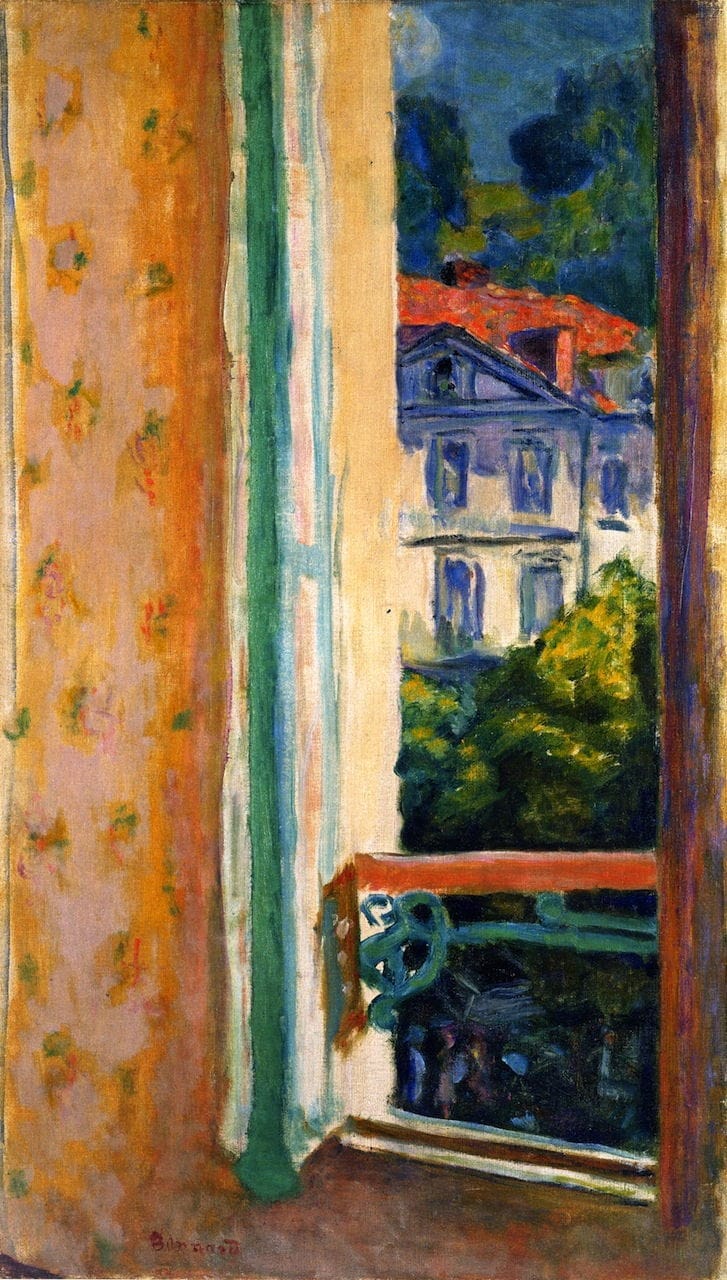
[Another painting by P. Bonnard. Sanilac’s comment right below it: “Life here is what we have, and if we perceive it to be worth less we will feel impoverished while living.”]
JS: The summary above is roughly correct, though I would never present the rationale for the four-realm architecture to readers first, because it is the most complex part of the system and obscures the deductive method besides. Also, this account does not sufficiently express the fundamental importance of indeterminacy, on account of which God does not exactly play a teacher role.
BP: Yes, intrigued readers must study Optimalism for themselves.
[Compare Sanilac’s Daily Journal, October 12, 2026,
on how bad LLMs may be in that, at least at times.
Then in October 14, Sanilac posted a gentle intro to Optimalism.]
But how did you come up with the idea of Optimalism?
JS: I spent a lifetime musing on these problems in spare moments. Bizarrely, I have an early childhood memory of wondering how reincarnation could square with population increase: I imagined that perhaps there was a reservoir of people on the dark side of the moon whence we were drawing. Such a ridiculous thought that I must have been five years old.
In any case, around 2020 I came up with the idea of analyzing all religions’ core beliefs in terms of their effects. Pragmatic justification of religion has a long history that goes all the way back to Plato’s Republic, not just James and Pascal; but it had always been undertaken very timidly, whereas I resolved to undertake it comprehensively, and from first principles. This led to a series of investigations that I released serially to my readers, and eventually compiled and published under the title “A Pragmatical Analysis of Religious Beliefs.” Around 2022 or 2023 I rewrote that essay to better state its arguments, and expanded it with some further investigations.
By then I had already formulated the principle that we should judge beliefs about unknowables by their practical effects, which I called the pragmatical principle. However, I was still missing a few critical elements that would make these beliefs hang together, because they did not yet exist in any previous religion. The chief issue was the problem of integration identified in V.1 of Optimalism. For a long time I was unable to solve it. I kept testing variants of a three-realm architecture, and they kept falling short in one way or another.
Then late in 2025 I began studying various forms of Buddhism in preparation for my next novel. While I had always considered Pure Land ridiculous, it suddenly occurred to me that I was mistaken. There was a genuine motivation for the move it made, because there really did need to be some intermediary place between our present world and our final destination that wasn’t bardo itself. Now, to be clear, the Pure Land as such was not the answer. What I’m saying is that it pointed me toward the right solution space. So I began to explore that solution space, and soon arrived at the highly counterintuitive introduction of a fourth realm. The really surprising thing was that this fourth realm wasn’t just an ad hoc patch. Instead, the proposed architecture mirrored the process of learning on a very fundamental level. That’s why it shows up in machine learning as well.
Around this time life wasn’t going particularly well for me. All of my projects had bombed with the public, and I’d become sick as well. I seemed to have no prospects for material success. I didn’t think anyone would read a difficult philosophy book deducing a new religion, but then, people weren’t reading my more commercial writing either. So, basically I decided to throw it all away. I dropped everything to write Optimalism. To discover and express the final form of the logic ended up taking about eight months of working around the clock, or at least whenever I was lucid.
BP: How do you think Optimalism should look like if spread among the masses? Art, temples, churches, denominations, factions, involvement with social ethics, education, politics, whatever.
JS: It’s far too soon to talk about Optimalism spreading amongst the masses. Even if it were possible, it would be a bad idea at this stage. First there needs to be a long period where a smaller number of high-ability people — thinkers, artists, scientists, entrepreneurs — work together to understand the ideas and elaborate them in the directions indicated. Into local ethics, imagined presentations, social organizations, and easily comprehended explanations. For the time being all effort should go into building this high-ability community of founders, and the masses should be left unperturbed to believe whatever they believe, so long as they don’t infringe on its freedoms. Now, to be clear, I do not mean the average man need be excluded early on. Only that he should not be sought out until the elements just mentioned are mature.
A few times in Optimalism I briefly allude to an architectural concept for a contemplative temple called the liminal ring, but this is only a suggestion. The field needs to be left open for many individual artists who have understood the core principles to give them expression in diverse forms. Initial attempts will mostly fail, but through trial and error, the community will eventually find effective approaches.
What I would emphasize more broadly to anyone reading this interview is that while Optimalism has a complete set of rationally deduced core beliefs, it is nevertheless incomplete when considered as a whole religion; and your talents can make a meaningful contribution to founding it.
BP: Why didn't you state in Optimalism positive arguments for God's existence? (Other than abstract appeals to basic religious intuitions.)
JS: I don’t find these sorts of arguments especially sturdy or interesting, and they would have weakened the deductive method, which was already sufficient for the purpose.
BP: Don’t you underestimate, e.g., the quality of certain (not very well-known, I admit) historical arguments for non-optimalist religions from putative miracles?
This February, I posted:
The first Christian martyrs allegedly died clinically sane yet insisting they’d personally encountered the risen Jesus.
If that is historically solid, it raises the probability that Jesus is more than a moral teacher. It’s rather hard to die as a sane person for a false empirical claim. So perhaps a good God who does have some good reasons for allowing all the brutality really did back Jesus up and also what Jesus said, including that Jesus was God himself, somehow. (See esp. the McGrews’ philosophical and historical work on this. Very imporant! I’ve never seen anyone explain the evidence better. Never ever. Also, the common strategy is to just ignore or lie about it. Once I wrote a Czech paper summarizing one version of their argument. They’ve improved it since then.)
JS: In my view traditional religions’ claims about historical miracles are not remotely credible. Beyond that, they are theologically dubious as well, because a valid solution to the problem of evil is not compatible with miracles. Furthermore, their historical and geographical specificity is extremely arbitrary. So they fail on multiple levels at once. I dismantle them schematically in VII.8-11. And I could easily make a much longer case against them, but I view it as unnecessary. Many others have already done so.
I prefer not to address the details because doing so would needlessly offend adherents to traditional religions, many of whom wrongly assume historical miracles are necessary to underpin religious belief. Optimalism demonstrates that this is simply not the case. On that point I also refer readers to proposition A.17, where I address Optimalist-compatible reinterpretations of traditional religions.
BP: I will press on the problem of evil. Some horrors (think the case of Junko Furuta, or some ugly horrors in the animal world) are so horrific that it’s hard to believe wtf could be God’s reasons for letting them occur or go on. Nothing seems to qualify. This is also Michael Huemer’s reply to Joshua Rasmussen, whose views on God, religions, and meaning of it all are similar to yours. If a witness to the brutal tortures of Junko Furuta (Huemer doesn't mention her, I do here) failed to intervene so as not to spoil the overall soul-building drama or the torturters’ free will, that witness would be considered callous to say the least. A supreme being should have the ability to prevent at least such megabrutal suffering without thereby destroying the overall value of the world.
(Listen around min. 1:26:00.)
Yes, this is old news, Ivan Karamazov says similar things. If you say in reply — maybe like, e.g., Peter van Inwagen in The Problem of Evil (2003, chs. 6 and 7) — that the matter of what God can or cannot permit is objectively vague and so he must draw the line somewhere somewhat arbitrarily, the problem remains that Junko (and many many other things, both in the human and animal world) are still too much too brutal to not make God seem at least callous. I don’t say there’s no good reply to all of this, but it should be stated in Optimalism, IMO.
JS: In my view your concern is answered in I.5N:
Any demand for a non-arbitrary (D.13) intervention from God therefore collapses into a demand for absolute and pervasive interference of a degree that would void indeterminacy entirely (I.3-4).
The text of Optimalism is not intended to be reader-friendly, but to be philosophically perfect. I wasted a lot of time making my previous works reader-friendly and in the end it didn’t make a difference. And, I just wasn’t going to waste my time on it again. It’s also philosophically inelegant to be overexplaining everything. What was important to me for Optimalism was that it was all there in plain language with no obscurantism, stated in the most economical and precise form, so that people who wanted to figure it out and took the text at its word could always do so, at least with a little help from LLMs.
Of course, if I encounter some vital issue that I really don’t think is addressed, I will add it. But in this case — although you may continue to disagree — I am confident all of the issues you’ve raised are addressed very directly in I.5N, provided one reads each sentence with the assumption that it is doing important work. It’s really just a matter of not underestimating the text, which has been worked out with extreme intricacy. I believe the more seriously and carefully you read it, the more you will see the necessity of the logic.
[BP: Here I help myself with NotebookLM again, to nail down why Sanilac insists he has solved the problem of evil.
Capping the threshold on allowed evil is logically unstable (I.5N). This is based on two pillars: the infinite proportioning effect of the afterlife, and the sovereignty of the law of non-contradiction.
If we argue that God should allow some suffering (to preserve freedom and build virtue) but should draw an absolute line to prevent the worst megahorrors (a capping threshold), we create an equation that is mathematically and logically unstable.
In Optimalism, the ultimate payload of creation is the upper realm — an eternal, maximally good final state (D.21, III.15). Because this final state is infinite in duration and quality, it produces an endless, infinite flow of positive utility (I.5N).
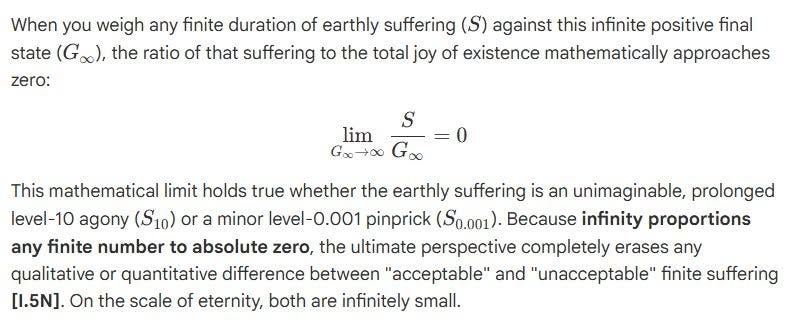
This mathematical limit holds true whether the earthly suffering is an unimaginable, prolonged level-10 or a minor level-0.001 pinprick. Because infinity proportions any finite number to absolute zero, the ultimate perspective completely erases any qualitative or quantitative difference between “acceptable” and “unacceptable” finite suffering (I.5N). On the scale of eternity, both are infinitely small.
Because the final state of spirits is maximally good, it “excludes net neutrality” (I.5N). The universe is not a wash; it is infinitely positive on net.
Under this infinite mathematics, if you reject a large quantity of unproductive evil, you are logically obliged to reject the smallest quantity as well (I.5N). Because if a finite horror carries enough objective moral weight to invalidate God’s goodness, then any amount of suffering must carry that same weight. There is no stable attractor, no logical ledge, and no mathematical plateau where a line can be drawn on a continuous spectrum of pain (I.5N). If God must step in to stop a level-10 horror because it is “too much,” the exact same logic immediately demands He stop a level-9 horror, a level-5 horror, and eventually a level-0.001 discomfort.
Because any arbitrary safety cap is logically unstable, the threshold inevitably decays all the way down to zero.
To enforce a cap of zero suffering, God would have to engage in absolute and pervasive divine intervention (I.5N). He would have to physically override the trajectory of every colliding particle, rewrite the laws of biology on the fly, and constantly intercept human intentions.
By intervening to this degree, God would completely void the intended indeterminacy (freedom/randomness) entirely. The training ground of the lower realm would collapse.
Now, why can’t God just arbitrarily decree a cap? Why can’t he say, “I am God, and I choose to arbitrarily freeze pain at exactly 100 units, regardless of whether the math is unstable”?
Because God’s primary creative intention is to develop independent, conscious entities who can genuinely co-participate in creation (I.3). To generate co-creators who are truly distinct from himself, God must use indeterminacy (I.4). Without indeterminacy, his creatures would be mere puppets, arms, or passive echoes of his own immediate will (I.4).
If God writes physical laws that cap suffering, he must systematically interfere to enforce those caps. The moment he does so, He turns the universe into a padded simulation (VI.1). Under VI.1, a simulated or dream-like world is less real, which makes our choices less meaningful and lowers the moral stakes of our decisions (VI.1).
God cannot arbitrarily cap evil because doing so would actively destroy the very thing he created the universe to achieve — it would render his own primary creative project redundant and void (I.3, I.4).

(A comment at Sanilac’s Gumroad.)
Also, Optimalism is a rational deduction, not a mythology of divine whims. Under D.13, any valid set of beliefs must conform to the fundamental principles of reason, remaining logically sound, non-contradictory, and parsimonious. If God governed by whim, He would introduce arbitrary “epicycles” into the very laws of physics (V.20N). A physics where the laws of nature arbitrarily warp to protect us (e.g., carbon bonds becoming indestructible only when an act of violence is intended) is highly unparsimonious.
Believing in a chaotic, ad-hoc, “kid-safe” physics carries a massive belief-cost (D.14), straining our intellectual probity to a degree that makes the religion suboptimal and impossible to rationally credit (D.14).
Finally, religions often imagine a God who legislates morality like a human king, making arbitrary rules and gating heaven by whim. Optimalism rejects this (VI.13). Moral fundamentals are enforced by the law of non-contradiction itself.
God is not “choosing” to be non-arbitrary as if it were a lifestyle choice. God is bound by the law of non-contradiction because logical consistency is the very structure of his divine consciousness.
A God who attempts to run a universe that is simultaneously undetermined (so spirits can grow freely) and arbitrarily limited (to prevent free particles from ever colliding too hard) is attempting to create a square circle.
Because even an omnipotent God cannot perform a logical contradiction, the law of non-contradiction stands as an absolute, unyielding barrier. It locks the universe into a binary choice: either indeterminacy (which guarantees natural and moral horrors will occasionally occur) or determinism (which voids the soul-school entirely).
By choosing indeterminacy, God chooses the only logically possible path to develop genuine, free spirits capable of inheriting eternal, co-created joy (I.3, VI.18).]

BP: How to identify one’s tasks in this lower realm, and how to tell these genuine tasks from random flukes this realm is full of?
JS: There is no way to identify our tasks with absolute confidence, and that is why we infer them from their alignment with the good. This is explained in Optimalism IV.6:
We have no way to determine our specific tasks in the present life. But since the optimal beliefs about unknowables (D.10) are those that achieve the maximum net good in this life and the tasks we must complete are those that do the most good (IV.2), the optimal means to complete our tasks follows tautologically (D.1). Thus, it is optimal to believe doing the maximum net good in our present life also makes the best progress toward the completion of our tasks (D.17).
IV.6N. This proposition precludes speeding afterlife development by engaging in present-life-net-negative behaviors such as unduly risky novelty-seeking. However, it does not imply tasks (D.18) are a mere relabeling of the same aims one would intuitively pursue in the absence of belief. Tasks may make claims on us that are underdetermined by knowns (D.9), and to identify them we must consider their effect on the whole (D.2). For example, a man in the grip of addiction will often realize greater net good by adopting the religious belief that he is charged with some task his immediate perception does not specify or insist on. This can be true in less fraught cases as well. Moreover, framing a task as relevant to development (D.7) may shift one’s comportment and perceptions in ways that are beneficial on net even when afterlife consequences are bracketed (D.1b). This is why a sense of mission can be intrinsically rewarding.
BP: As the last topic, I will ask you about something concrete and related to the entropic nature of the lower realm.
In your recent Journal entry from Sep 12, 2026, you expect a slow-moving global depression and fertilizer/food crisis by 2027–2028, engineered by US elites. Their goal would be to destabilize global supply lines to prevent China from exporting its demand deficit and allow the US to force domestic industrial reshoring. That would impoverish the world but secure more of US dominance.
Incidentally, in his last podcast episode, around min. 17,

BAP discusses something similar. Plus, and this adds the context, across his writings he has condemned the current Western regime as an ossified, anti-meritocratic authoritarianism of clerks, women, and olds that systematically suffocates and excludes intelligent, ambitious, young men (e.g., 1, 2, 3). So in the said podcast episode, he admits that if some crash could cleanly wipe out the corrupt duopoly of Wall Street and Silicon Valley to clear the way for a genuine meritocratic reset, he would support it. But he doesn’t believe that, e.g., an oil-driven crisis stemming from Middle East war would deliver that kind of reset. It would inflict severe economic pain on average working-class citizens, including Trump supporters. Also, a chaotic global collapse would likely empower the left to enact even worse policies and allow China to step into the #1 world position, thus subjecting the West to a century of humiliation. Unlike you, BAP also rejects that a calculated US grand strategy is going on. He thinks elites are more influential than normies think but less competent than dissidents think, and he attributes Trump’s Iran escalation to unstrategic establishment boomer disease and a desire for easy foreign flexes because salient domestic reforms are mostly blocked because of the constitution and other fucktors.
Comments welcome, of course.
But anyway, does the quite likely impending era of global depression, food scarcity, and/or geopolitical breakdown present co-selected tasks for individual souls in this lower realm today, or is it an accidental macro-level friction that they must simply navigate and endure?

[Famous site by Joel van der Reijden, who happens to be a social democrat in fact.]
JS: First, I want to make quite clear that my online journal consists of casual, freewritten thoughts that are often ill-considered, moody, or wrong. I make it available only so people can see my day-to-day thinking and understand there’s a person behind the work. The rest of my writing, in contrast, is very thoroughly considered and carefully stated. So, I view these as completely separate. And if someone looks back and says, “Check out all these wrong and silly ideas I can quote from Sanilac’s journal,” well, the journal was never intended to be held to a standard. As a further disclaimer, I’m not a geopolitical analyst and haven’t published anything pretending to be; when important events occur, I think about them just as everyone else does, that’s all.
In any case, I’ll try to answer your questions in one go, but I hope everyone keeps this disclaimer in mind.
As some general background, while the West is facing a number of serious problems now, the most fundamental diagnosis, in my view, is ponerocracy. The idea here is that evil people eventually find ways to rise to the top of the political system, and then they transform it so that it rewards further evil, and this creates a feedback loop that eventually affects people on every level — to the point that the virtues of average citizens are degraded (which we are well past). This was the theme of my novel Memoirs of an Evil Vizier. [BP: See again also Sanilac’s Journal, entry from August 7, 2026; and this section of his essay on “Trust Networks.”] Since around the middle 20th century we’ve had a rather unique manifestation of ponerocracy, with some critical nodes increasingly organized around intelligence agencies and blackmail. This culminated in the Epstein conspiracy [BP: compare here].
There is a naive rationalist view that conspiracies can’t be a thing, evil people aren’t really a thing, and all bad outcomes are just the result of misaligned incentives. This view makes people feel really smart and objective, because it lets them explain everything with a kind of abstract systems analysis, and then they can smugly dismiss other approaches as ignorant and paranoid. There is a popular article called “Moloch” or some such floating around, with the idea being that there isn’t really a problem of conspiring evil people, but just bad incentives that we mistakenly personify. Well, as a model of how the world works, this is wrong. Yes, of course many things are like that. But evil is an essential reality, people matter, and conspiracies are real and important; and you can’t understand the world without understanding these things.
The Epstein ring is the foremost example. It’s an extremely evil and extremely important conspiracy run by a foreign intelligence agency from a small nation in the Middle East in coordination with an allied faction in American intelligence agencies, and it ensnared a large number of the most powerful people in America, including at least one president. Now, did it ensnare them to do nothing but have parties on an island? Of course not. It ensnared them to shape policy and the direction of society in a manner completely independent of any normal incentive structure a rationalist could analyze in daylight. We can see a much more mundane example of conspiracy in social-media censorship. One might come up with all kinds of excuses about how market forces or incentives made social-media networks censor in this or that way, or even deny that censorship was happening — and people did all of those things. But at the end of the day it turned out there were literal intelligence agents making decisions behind closed doors and guiding the censorship, with an agenda. A famous historical case is abstract expressionism, now very well documented as conspiracy fact.
I’m not going to take the time here to demonstrate that fundamentally evil people are a thing, because that should be obvious to anyone with a brain, but keep in mind that the character of the person making a decision matters, not just the incentives. That’s absolutely critical. The particular allegiances of the person matter too, both tribal and ideological. And those don’t fall out of abstract incentive structures either. Furthermore, market forces don’t fully cancel out these factors, even in “commercial” entertainment media.
So, ponerology and the reality of conspiracy are the two analytical approaches I bring to bear on our present situation that the average intelligent person today does not give much currency, or at least sufficient thought.
On, then, to the Iran War, about whose origins and motivations I have to speak much less confidently, because so much remains obscure, and guessing to fill in the blanks can easily be wrong.
The Iran War is something I was very strongly against from the start. I almost never make a point of stating my views on specific political events, but because this one was uniquely bad, I criticized it as loudly as possible for several weeks when it began, both on social media and in my journal. While starting this war was certainly quite evil, the reason it happened at all is harder to say.
Three explanations present themselves. First, stupidity; second, the influence of the country behind the Epstein ring; and third, competition with China. Initially the first two reasons appeared to be the best explanation, but as the war dragged on I began to see the third as more and more important, and at present, I would argue for all three. When it comes to political events there are very often multiple causes. That’s because events have multiple consequences with multiple implications, and are usually driven by multiple factions with different interests. So, there is nothing particularly strange about saying, “It’s all three.” I’m only going to elaborate on how I think the third reason works here, because it’s the least obvious.
The explanation requires some economic background. I am not an economist, so for a through and correct explanation I will refer you to Michael Pettis and others who have analyzed this, but I’ll try to present the rough idea. China is running a mercantilist economy where they suppress consumer demand in order to increase production faster and enjoy a competitive advantage in the global market. Their competitive advantage is not so much that their productivity is remarkable, but that they don’t pay their workers enough to consume what they produce. However, unless they’re just going to throw the output into landfills directly, someone needs to consume it. So, they sell it to the rest of the world, and especially the West, which produces less than they consume.
Why anyone would do this is of course not immediately obvious. But if you think back to the earlier stages, it made a great deal of sense, because China was so underdeveloped. Then it was reasonable to say: instead of consuming, we’re going to invest as much as we can in building roads and bridges and factories, and just grow as fast as possible. And they did, and it worked. But eventually you reach the point where you have all the roads and bridges you need, and you have enough factories to produce all the shoes you need, and making the tenth bridge across the same river or a shinier bullet train to impress foreign visitors doesn’t add much value. And then you have to make a choice: are we going to slow down and consume more of what we produce, or are we going to maintain our nominal growth rate by following the same path even though it’s no longer creating the same amount of real wealth? And China chose that second path. The critical exhaust valve to make it work is exports.
On its surface, this might look good for the West, and some argue it is. China is basically going to produce too much stuff and sell it to us at a discount, on credit. So we give them pieces of paper, and they give us stuff. But there are second-order effects. If we buy widgets from China, our own widget factories are going to close down. Well, when they’re just producing cheap junk, we don’t care a whole lot. But eventually they’re producing washing machines and then electronics and then cars, and we keep shutting down more and more factories with higher and higher value. Where do those factory jobs go is a question I don’t want to get into here; the important point in the present context is that we are increasingly deindustrialized, and sometimes in geopolitically relevant industries like rare earths. Furthermore, when you have interconnected clusters of these industries you get productivity and technology advances that you can’t get any other way, and this ends up driving real gains.
To make a crude analogy, China is selling us fish on credit at a discount while teaching itself to fish and then to make nets and then commercial fishing vessels, whereas we’re dismantling our commercial fishing vessels, forgetting how we even built them, and consuming cheap fish on credit as if nothing could ever go wrong. And this is happening across many of the industries where the greatest productivity gains tend to occur.
We’ve recently reached a point where this becomes a genuine threat to American dominance. The correct solution is to intervene to forced balanced trade, and there are a few ways to do that. But, they’re hard to coordinate, both in terms of internal politics and international politics. (Also important to note that some factions in the West have profited from this system. The financial winnings have generally concentrated at the top. That’s why it’s been so slow and hard to reverse.)
This is where the Iran War comes into play. In my view, the people who really make the critical decisions in the American empire — not the politicians who monkey around on stage for the voters [BP: compare here] — looked at this and said: we can stop the Chinese export economy in its tracks and bring home the factories in a single blow. Because if we cut off all oil from the Middle East, think about what happens. The global economy enters a depression, which means global demand craters. When global demand craters, China can’t keep exporting its demand deficit, long supply chains become fundamentally more expensive, and everyone rushes to protect their own industries. And not only that. It creates a perfect opportunity for us to put people to work rebuilding those factories with WPA-style programs and dirigisme, which is already becoming the policy — and in that sense slack employment actually becomes a perk. So, we accelerate reshoring dramatically, and have a political mandate to get the job done. As a cherry on top, America has much better native oil production than China or Europe. And China can’t follow this kind of standard stimulus policy to deal with depression nearly as effectively, because it’s already overbuilt and overstimulated to the max, while the reduction in global trade will expose vast physical misallocations. The end result is an accelerated shift in the balance of economic power in favor of America and to the disadvantage of China.
You can criticize this analysis as one of those “triple-bank-shot” theories that’s just way too complicated for its own good. But it’s really just a single bank-shot theory. Vandalize the global economy, with the expectation that the American economy is in a much better position to deal with the consequences than China. Again, that doesn’t make it a good idea, and not just because it’s evil, but because starting a war is like opening a door into a dark room.
Thus far this theory has performed extremely well (I’ve articulated it numerous times in my journal, dating back to May 20th of this year, and not just recently). Because it has quite correctly implied that all the negotiations to end the war would be kayfabe. The point was never to end the war, but to prevent oil and gas from leaving the Middle East long enough to crash the global economy, without the US having to take the blame for bombing anyone other than Iran.
That said, what is my confidence the theory is correct? Not super high. There are a lot of unknowns and a lot of speculation to fill them in. The reason I’ve bothered writing it up in detail is here that I don’t think many people have considered it in full (certainly others have proposed the “cut off china from oil” idea, but that isn’t quite enough), and the theory is, at a minimum, worth mulling. Amusingly, if it turns out to work perfectly, everyone will end up blaming the stupidity of the current president for what amounts to a “drunken master” knockout punch by the rulers of the American empire. You could hardly script a more perfect fall guy. It’s also worth pointing out that even if competition with China wasn’t the original motive behind the Iran War, the outcome might be the same regardless; and it would be extremely unsurprising if the American national security state took steps to capitalize on that.
Do I think any of this is going to improve life for American citizens? Certainly not. It’s driven by a small, coordinated group of evil decision-makers at the expense of almost everyone in the world. Presumably we’re all going to be poorer for a considerable period before the new economy takes off. Given Europe’s current leadership, it will likely be slow to adapt and hollow out further before it begins to reindustrialize. The developing world is going to be in even more pain. There were much better and less destructive ways to reshore; and beyond that, we plainly shouldn’t be blowing up somebody else’s local enemies in the Middle East at our own expense.
You say that BAP “attributes Trump’s Iran escalation to unstrategic establishment boomer disease and a desire for easy foreign flexes because salient domestic reforms are mostly blocked bc of the constitution etc.” I don’t think that’s correct at all. Even and especially if explanation #3 (economic competition with China) turns out to be wrong, which is possible, explanation #2 (the Epstein ring and the interests behind it) surely had an important influence on the decision to start this war in violation of clear campaign promises and the public will, and the president is by no means innocent of involvement. Furthermore, ponerocracy, corruption, and the harmful influence of certain groups are not left-versus-right problems but profound, systemic issues affecting both sides, and partisan politics is often just a convenient distraction (which is, of course, not to say both sides are equivalent on all issues).
Lastly, with reference to your question about Optimalism, it’s important not to interpret every difficult circumstance as a task that’s been neatly designed for us. While we should generally interpret inclement circumstances as presenting us with meaningful tasks, it would be inappropriate to interpret specific geopolitical circumstances through a religious lens, or assume them to be an obstacle course designed for our benefit. Events in our world are produced through indeterminacy, and although we — as particular spirits rather than others — may be thrown into them because the circumstances are relevant to our course of development, that relevance is still limited by indeterminacy, and the fact that loci of experience themselves arise from an indeterminate field of events. On this point see Optimalism IV.12 and VI.5N.
IV.12. It is not optimal to believe all circumstances present us with genuine tasks.
The lower realm consists of free entities sometimes at cross-purposes (D.20, I.3). So there can be no guarantee the resulting circumstances must always present us with genuine tasks. And to believe they must would force us to interpret even the most pointless circumstances as productive. This would push us to endure torments for no purpose. But enduring torments for no purpose is a harm without a benefit (D.2). Thus, it is not optimal to believe all circumstances present us with genuine tasks.
VI.5N. If we were to insist our lives are so well tailored that there must be benefits and opportunities where we observe harms and closed doors, we would force a dissonance between belief and observation that exceeds the limits of probity (D.2, D.14, IV.12). If we were to insist instead that they are wholly random, we would be discouraged by the absence of meaningful connection to our tasks and larger development (D.7). Optimal beliefs take a middle position. The challenges and opportunities in our lives are aligned with our tasks and development meaningfully but imperfectly, because our co-selection of lives is constrained by dependence on other undetermined entities (III.10N, D.20, I.3). We should default to framing our struggles within this sometimes cryptic alignment rather than its imperfection, but not insist (IV.20N, IV.5N, IV.12). This middle position maximizes net benefit after accounting for belief costs consequent to knowns. So we could prove its optimality directly (D.1 + D.2 + D.10-11 + D.14) even if it did not already follow from prior propositions.
Addendum
Sanilac’s tweets and journal entries on our interview:
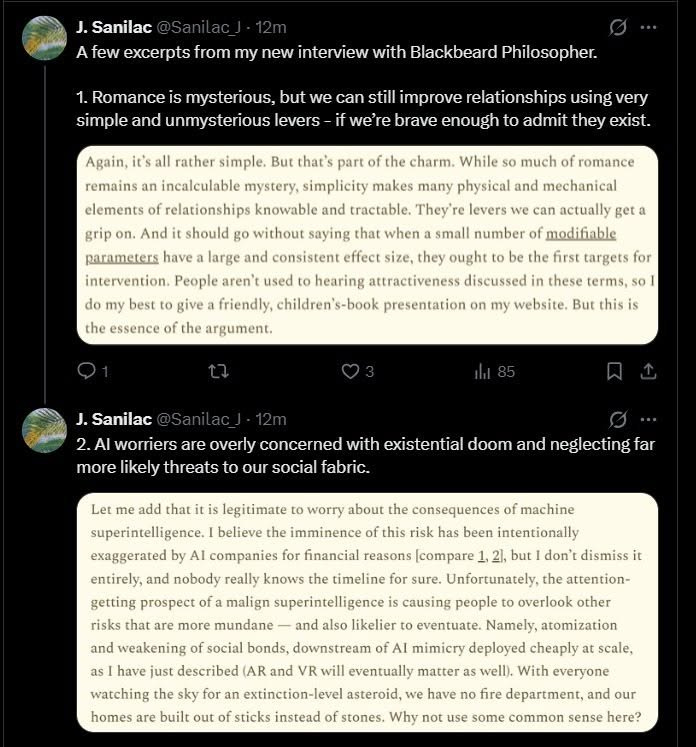
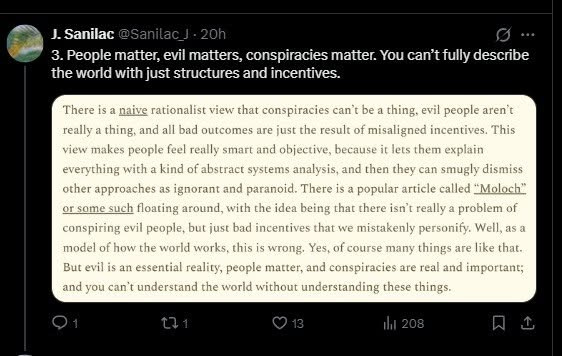
I agree.
More:
Journal entry from October 1, 2026.
October 2.
More by NotebookLM on the problem of evil:
If J. Sanilac were to step into the ring with Michael Huemer to address the return of this nightmare scenario—where future technology makes inescapable, prolonged tech-torture physically possible and suicide is blocked—**he would not flinch.**
Sanilac would not offer a soft, sentimental escape hatch. Instead, he would turn his unyielding deductive lens directly onto Huemer's own philosophical commitments. He would argue that **Huemer’s "bystander" critique fails because it relies on a flawed, dualistic metaphysics and a logical double standard that Huemer himself spends his career fighting in population ethics.**
Sanilac's exact reply would be built on three devastating, systematic steps:
---
### 1. The Metaphysical Defeater: The Illusion of the "Bystander" (A.13 & I.10)
Huemer’s "serial killer neighbor" analogy assumes a standard **materialist or dualist metaphysics**—where a physical victim exists independently of God, and God stands "outside the room" like a callous bystander refusing to intervene.
But under *Optimalism*, **Idealism is the mathematically and logically optimal solution to the mind-body problem (A.13)**. This means:
* Physical matter has no independent existence outside of consciousness; **"matter is only a consistency in the contents of consciousnesses,"** governed by the primordial principle of universal harmony.
* Because God is omniscient, His mind is not detached from this system. He has absolute first-person knowledge of every subjective moment in creation.
* Therefore, as a direct mathematical corollary of His nature: **"when someone suffers, God suffers with him".**
When Junko Furuta was tortured, God was not standing outside the window watching a separate entity suffer to preserve a "principle." Because the physical world is a structured projection of consciousness, **God was inside her consciousness, intimately experiencing the exact, unmitigated first-person agony of the torment.**
If future technology is used to extend a victim's life and torture them, **that torment is God's own torment.** The choice to allow indeterminacy is not God letting *someone else* suffer; it is **God choosing to subject Himself to the horrific, accidental exhaust of His own free physics** because He holds the creation of independent co-creators as a primordial, non-negotiable good. God is the victim of the serial killer, not the neighbor who stands by.
---
### 2. The Cosmological Defeater: The Hard Temporal Cap (A.2)
Huemer’s scenario of "a million, billion, or trillion years of tech-enabled physical torture" is a mathematical and physical impossibility under the fundamental laws of our universe.
* Under **A.2**, Sanilac deduces that **our world (the Lower Realm) is strictly unique, has a finite temporal duration, and does not repeat cyclically.**
* If the Lower Realm were infinite in duration, the probability of redundant outputs would rise to the point of complete predictability, **reducing the freedom of the physical system to mere nominal status and voiding its purpose.**
* To maximize freedom and originality, the universe must have a **finite, hard temporal cap.**
Thus, while future technology can prolong a fragile body's life temporarily, **it cannot torture a spirit for a million or billion years.** The physical Lower Realm has an unyielding, systemic expiration date built into the math of its initial physics. Once the clock runs out, the physical consistency dissolves, and every spirit—including the victim and the tyrant—is pulled back into the non-physical safety of the Liminal Realm.
---
### 3. The Logical Defeater: Huemer’s Double Standard on Transitivity (I.5N)
Sanilac's final, most devastating blow would target Huemer’s own intellectual consistency.
In population ethics, Huemer is a fierce defender of the **Repugnant Conclusion**. He argues that when presented with a series of logical, transitive steps, **we must follow the mathematics of value where it leads, even if our raw, aesthetic moral intuitions scream in horror.**
Yet, on the problem of evil, Huemer commits the exact error he critiques in his opponents: **he lets his local, emotional "seemings" override the unyielding mathematics of infinity.**
Sanilac’s proof in **I.5N** uses Huemer's own mathematical transitivity:
1. Because the Upper Realm is infinite in duration and quality, it produces an **endless flow of supreme bliss.**
2. Relative to infinity, any finite duration of suffering (\\(S\\))—whether it is a minor pinprick (\\(S_{0.01}\\)) or eighty years of horrific torture (\\(S_{10}\\))—**mathematically approaches absolute zero: \\(\lim_{G_{\infty} \to \infty} \frac{S}{G_{\infty}} = 0\\).**
3. Because eternity proportions all finite suffering to zero, **there can be no stable, logical attractor or "cliff-edge" on a continuous spectrum of pain.**
4. If we demand that God step in to stop level-10 horrors because they are "unacceptable," the transitive math immediately demands He stop level-9, level-5, and eventually level-0.01 discomforts.
5. Thus, any threshold for intervention **inevitably collapses into absolute, pervasive divine interference, voiding indeterminacy (freedom) entirely and turning us into pre-programmed puppets.**
Sanilac would look Huemer in the eye and deliver the ultimate verdict:
> *"You cannot have it both ways, Michael. If you accept the unyielding, transitive math of value aggregation to defend the Repugnant Conclusion, you must accept the exact same transitive math in **I.5N**. You must accept that there is no logical stopping point between a pinprick and a horror relative to infinity.*
>
> *If you demand a God who arbitrarily breaks His own physical consistencies to 'pad' the world from extreme choices, you are demanding a square circle—a universe of puppets. You are letting your local, human-level emotional seemings censor the grand, elegant, and unyielding equations of the cosmos."*
https://www.bronzeagepervert.yoga/p/emergency-medication-politics-after