
The Goid
God/Void

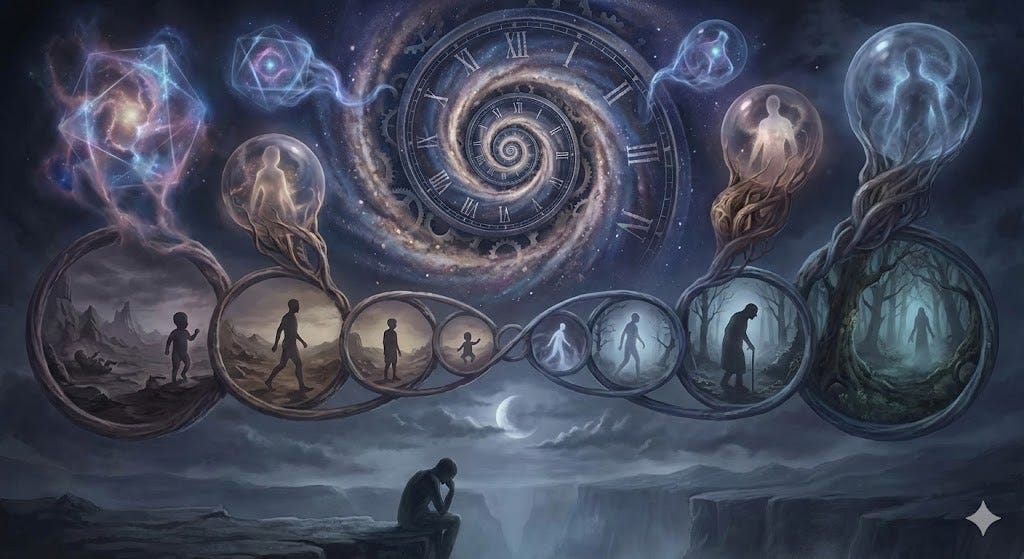
I composed the chief tenets here in a fit of existential anger.
Why is this so hard to settle, given it matters so much if it’s true?
Two philosophers struggle within me.
One of them says, Jesus is God.
The other, infinite time (or space) is “God” (the Ultimate).
Both are smart.
Philosopher A: The God Hypothesis
On a personal note,
· I don’t have convincing psychedelic God experiences.
· I don’t have strong paranormal evidence (reincarnation memories, mediums, ghosts). I’m suspicious most of it is fraud or self‑deception. (Michael Sudduth’s work is a useful antidote to naïve paranormal optimism.)
· I don’t feel God in prayer the way some people describe: not in church, not in nature, not with the clean (pseudo?)certainty that would make the whole problem dissolve.
· If you tell me I should “just have faith” without any decent reason or evidence, I think you are being retarded. Which may be okay if it makes you stronger, but is not my way.
Yet the God hypothesis won’t go away easily.
· Something started the Big Bang, or whatever stands in for it.
· The universe involves subtle regularities that make stable complexity within it possible.
· And those regularities even look oddly fine‑tuned for life based on carbon.
Yes, there is utterly ugly horrific brutality.
· So much intense grotesque evil.
· So, either the Creator is not good, not omnipotent, not interested — OR is operating with reasons I don’t grasp (atheists hate this option).
Moreover, important evidence for A is historical, not cosmological.
· The first Christian martyrs allegedly died clinically sane yet insisting they’d personally encountered the risen Jesus.
· If that is historically solid, it raises the probability that Jesus is more than a moral teacher. It’s rather hard to die as a sane person for a false empirical claim. So perhaps a good God who does have some good reasons for allowing all the brutality really did back Jesus up and also what Jesus said, including that Jesus was God himself, somehow. (See esp. the McGrews’ philosophical and historical work on this. Very imporant! I’ve never seen anyone explain the evidence better. Never ever. Also, the common strategy is to just ignore or lie about it. Once I wrote a Czech paper summarizing one version of their argument. They’ve improved it since then.)
For more on A, skim through BeliefMap.org, a superb site by Blake Giunta.
Philosopher B: The Void Hypothesis
Stranger and colder. Goes like this.
· Time somehow exists necessarily and is necessarily infinite (at least one‑way infinite).
· Given infinite time, time itself spawns space and energy, explores an enormous space of configurations, and infinitely repeats all those that are repeatable.
· If configurations are repeatable, then the same you‑conditions recur. Infinitely.
In other words, if the you‑conditions recur precisely enough, and given infinite time there is enough time for it, that counts as another incarnation of you. In fact the count is infinite.· Thence, fine-tuning and reincarnation even without anything supernatural. Infinitely.
Btw, the Bing Bang is hardly a disproof of infinite past, as Michael Huemer shows. Also see this post of his. Or listen to these two philosophers:
I set aside whether B can explain the evidence around Jesus, and how good the evidence is. I must take a better look at it some other time, much better look than so far. (Most people don’t look at it at all, or very poorly.)
Now, are you really repeatable? Take Huemer again: in the worldview such as that stated above, reincarnation is “surprisingly plausible.” If the history of the universe is infinite, then you will be infinitely reincarnated. The important argument is this: if time is infinite and persons are repeatable, then conditional on your existence now, your repeatability becomes effectively certain — because given infinite time, your unrepeatability assigns probability 0 to your existence now, while your repeatibility assigns to it probability greater than 0. Below is his video lecture. (If you wish, see this, this, and this discussion of his with commenters.)
(Note how similar much of this all is to the the very end of Nietzsche’s Will to Power, §§ 1066-7. Though unlike Nietzsche, Huemer is not a determinist, and eventually tries to avoid the assumption that space is finite.)
Whence consciousness as such? The infinite time somehow has dispositions to spawn not just space and energy (and hence matter), but also protoqualia. Compare Peter Unger. This all eventually spawns minds bundled with bodies. Perhaps many minds even have free will. The bundling of minds with bodies is somehow necessary, though this smacks of the hard problem of consciousness again (why do the bundling laws hold?). Maybe Unger would rather say that the bundling had been — contingently?, i.e. not necessarily — in the ultimate, original, soupy source already, and the source later shattered into smaller bundles (minds+bodies). I don’t know.

(A review)
Anyway, as Huemer explains, minds reappear in infinite cycles, almost regardless of how you define their (personal) identity. (For some reason, Unger does not buy this. He thinks after death minds forever persist as disembodied and unconscious.) It is unknown in how varied forms they reappear, or in how good or bad lives. But most lives are quite shitty, so it seems there could be Samsara without Nirvana (without exit). That is scary, scary as hell, literally. Even in this irreligious, Void view, death is not the real danger. Afterlife is. Like in religions.
Buddha and Schopenhauer might not like this as too grim. There is escape, they think. But they were onto something when advising against suicide, regardless of God — and hell.
There’s a beautiful song by Current 93.
”If I cast my eyes before me, what an
Infinite space in which I do not exist;
And if I look behind me, what a terrible
Procession of years in which I do not
Exist, and how little space I occupy in
This vast abyss of time”
Well, yes and no. You mostly don’t exist in that terrible infinite procession, yet you exist there infinitely many times. And, possibly, mostly quite terribly.
Somewhat like Rust Cohle says in True Detective I.
(Cohle seems to be very much inspired by Nietzsche here, but unlike him, is just disgusted and horrified.)
The weak refutation — “that’s crazy, stop it” — doesn’t work on someone who can do philosophical thinking. So let’s try something else.
Finite stuff needed?
Huemer’s argument relies on the idea that “every qualitative state that has ever occurred will occur again, infinitely many times,” given infinite time. This is much more plausible if you assume
· finite energy or matter in a bounded region, or finite space,
· stable or universal laws that don’t drift or hold only locally,
· and of course infinite time.
Else, the recurrence becomes less obvious.
So the first steelman move for B is: stop saying “infinite” and empirically defend those assumptions, or show mathematically which are not needed and empirically defend the rest.
What is you?
Huemer explicitly says: “A sufficiently precise repetition of the right conditions will qualify as literally creating another incarnation of you,” but admits that some theories of persons rule that out. So B is firmer if he defends a specific account of (personal) identity that allows
· repeatability,
· or persons as gappy spacetime worms,
· or some other persistence condition.
Otherwise B may collapse into: a perfect copy exists but it’s not you. Which is not reincarnation but cloning.
Whence qualia and bundling?
This is the hard problem of consciousness. (See my paper about it.)
B needs
· protoqualia → qualia (sensations, feelings, attittudes, beliefs, etc.)
· qualia + matter → unified subject,
· unified subject → agency (maybe even free will).
You can’t endorse B without some consciousness metaphysics. Pure math of empty space or time won’t do.
Necessity needed?
B must answer
· why there is anything at all, such as infinite time,
· and why it has dispositions to spawn space, energy, protoqualia, etc.
If the Void (such as infinite time or space) wants to be “God” (the Ultimate), it needs at least necessary existence (even if not necessity of those dispositions). It can hardly avoid that. And it is to be seen whether the Void can exist necessarily.
—-
What to do while the meta/physics stays unresolved? Proposals in the next post.
The Pragmatic Goid-Experiment

In Zombies in Western Culture: A 21st Century Crisis (2017, ch. 5), John Vervaeke et al. dissect our zombie mythologies: hollowed-out Christian husks, political ideologies that birthed gulags, the pantheon of dead gods we keep trying to reanimate with various jumper cables. The result is meaning-debt, a gnawing loneliness as no shared story binds us, a …
Also take a look at this new post by Huemer, though as of now it is paywalled.
(I'm new here—even with the help of my AI, I couldn't figure out how to continue the thread—I'm responding to these thoughts https://www.whatswrongwiththeworld.net/2014/11/what_evidentialism_is_not.html)
Thank you very much for this wonderful (perhaps - probably) article. It answered questions I had given up on because I couldn't find the answers. Christians themselves don't know. I don't blame them, I don't know either. Anyway.
I have saved it—translated and underlined things—thoughts.
It is water that has refreshed me for another (long) journey.
I believe I will return to this reading because it solves my problems/questions.
How much to trust emotions, how much to trust logic, how much to trust even when the arguments are against it. It's deeper than that, I won't share any more.
Does my thinking have a limit? Yes, it does. But what kind, and is it deterministic?
Thank you for your fresh water and perhaps even a compass for when I'm not sure if I'm going in the right direction.
Powerful moments:
1) I don't feel God in prayer the way some people describe: not in church, not in nature, not with the clean (pseudo)certainty that would make the whole problem dissolve.
2) The weak refutation — "that's crazy, stop it" — doesn't work on someone who can do philosophical thinking.
3) I appreciate that you don't give up
Honestly, I feel like a primate that was suddenly placed on this planet. Now he sits on his ass in his room. And he is able to use a lighter to order a cooked zebra, which will be delivered to his room.
I think that faith cannot be understood by reason --> unless we make something an axiom. Because apart from things we can measure (the peak of my scientific knowledge :D), nothing can be proven 100%.
Alternatively, it can be proven that a hypothesis is false, although it should be noted that the possibility of an incorrect conclusion is always possible.
This (in my opinion) is called faith.
If one thinks honestly—and I am sure you do—without axioms, the ability to analyze any concept is very limited. The ability to question all aspects of a given topic is a fundamental principle that I learned during my time in the philosophy club. Ignorance is strength. War is peace. Freedom is slavery. 1984. The more knowledge, the more suffering. Solomon
The experience of being unable to feel emotions is a concept that is difficult for me to understand.
Experiencing emotional swings can be compared to the emotional upheavals depicted in the popular animated series "Phineas and Ferb."
My relationship with God has deepened greatly as I pray short prayers regularly, and when I feel that my prayer has been answered, I feel good.
I do this because otherwise I question and rationalize every miracle. The head is stupid. It doesn't know that hope is the most valuable principle/value.
A thought occurred to me: Did reason serve to help us survive? Just like emotions helped us stay in the tribe. In that case, reason must have a limit. That's not true, it's a tool that has evolved over thousands of years.
I also noticed that when I fill my eyes and ears with God/the Bible and think about Jesus, I believe more * I am stronger.
I am convinced that from a purely logical point of view, this situation is definitely depressing. This idea is completely absurd; it's like imagining how Santa, with his obesity, can slide down the chimney and then climb back up again.