
The Pragmatic Goid-Experiment
God/Void, again

This is a sequel to the previous post on the Goid: God/Void.
Keep reading till I tell you how to decide (or keep deciding) between those despite uncertainty.
In Zombies in Western Culture: A 21st Century Crisis (2017, ch. 5), John Vervaeke et al. dissect our zombie mythologies: hollowed-out Christian husks, political ideologies that birthed gulags, the pantheon of dead gods we keep trying to reanimate with various ideological jumper cables. The result is meaning-debt, a gnawing loneliness as no shared story binds us, a paralysis as no grand narrative feels truly beneficial, widely applicable, actually livable. Just an array of pieces pierced through pessimism, irony, and the aftertaste of failed utopias.
Likewise, in his online article “Pygmalion and the Anime Girl” (2023),
the astute anon scenarist Billionaire Psycho hacks at the Sovereign Individual delusion. That narcotic lie peddled to the masses: “You too can be a Nietzsche! A custom-built Gigachad! Education is the alchemy that turns base normies into philosopher-kings!” But the real result is a populace that’s very, very pissed off, as described by Chuck Palahniuk in his Fight Club. They were promised godhood, they were delivered wage slavery. Science, choice, freedom, emancipation, whatever – all sterile idols.
To make things worse, in his tweets of 2018,


Zero HP Lovecraft goes into the heart: God is dead to you. In your bones. Not intellectually but viscerally. You know, there, that the old magic is gone. You can’t feel the sacred aura like (some of) your ancestors did, only the industrial hum and the predatory emptiness of capital. Very Nietzche. Like others, you have traded transcendence for smartphones controlling distant dildos (ZHPL’s image, not mine; brilliant). But even if you discarded the tech like a luddite, you’d still feel robbed. Your poverty isn’t material but about this: because you’re so literate and educated, you’ve lost the naive faith in the past, the future, God, and crucially, ZHPL concludes, the ability to believe in happy endings. Such as the happy ending for your life journey. Many a song by Nine Inch Nails is a soundtrack to that freefall.
“Underneath it all
We feel so small
The heavens fall
But still we crawl”
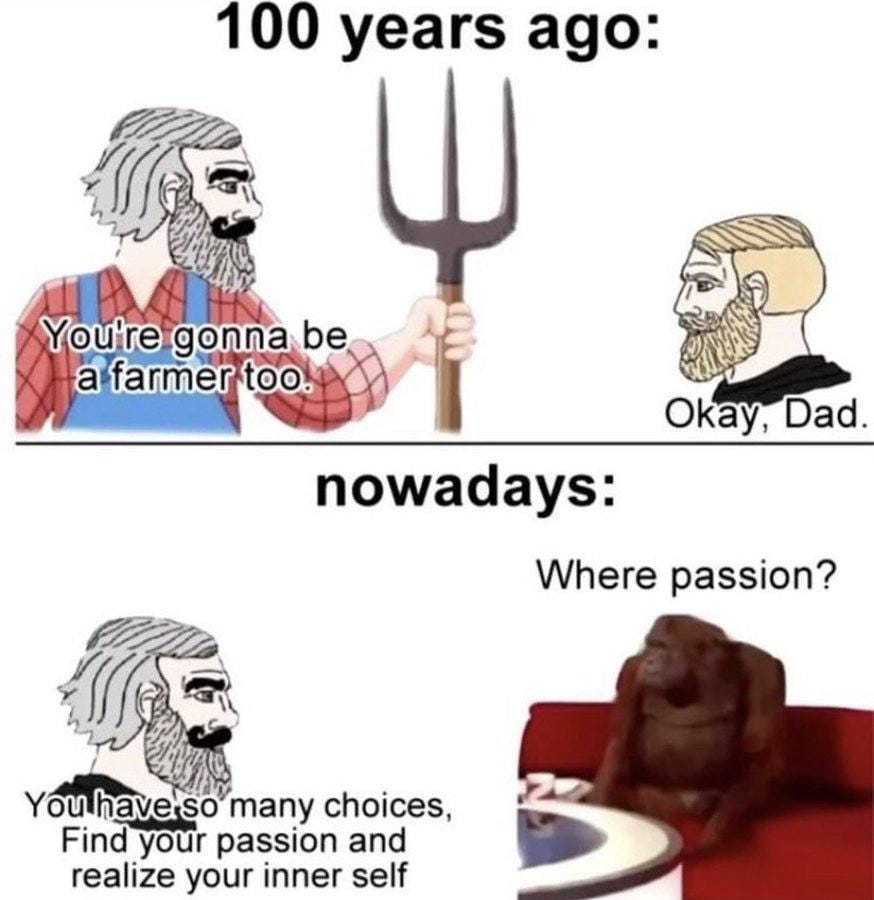
In The Gay (i.e., joyous, not ghey, you degen) Science §356, Nietzsche adds a note on the coup de grâce: lost predestination. No more divinely-ordained roles lending weight and structure. Just the terrifying, exhausting freedom to treat life as art, leading not to masterpieces, but to fleeting, shallow experiments. The will and passion to go for a true epic are crushed under the weight of optionality.
And there’s Lord Bronze Age Pervert and his BAM (Bronze Age Mindset, 2018), surveying the cosmic prison and saying how it feels inside: like escape is impossible, like you are trapped, not because oceans are uncrossed (they were crossed), but because it feels, maybe wrongly yet constantly, like there isn’t much to cross left. Like the only frontiers left are the barren outer space above (even Elon is ngmi, is he?) and the digital wastes below (the fake, pixel valhalla). The world feels small and artificial, a malevolent panopticon observed by a demiurge feasting on despair. Even fleeting raw moments are reprieves in a bubble you can never leave.
The problem for man as for other animal isn’t stress or suffering, but the feeling that one can’t escape: the despair and panic of exhaustion and entrapment. Beyond the borders of the known inhabited world, the oikoumene, there lay uncrossable oceans, including the great earth ocean of the steppe, and the Sahara in the other direction. China and India were known, and trade existed, but this was only a vague knowledge that could have, in theory, stimulated the sense of conquest and adventure. There were, in other words, plenty of possible sources for the feeling that beyond the known world still remained the unexplored. The same unknown that called the enterprise and spirit of the Portuguese, Spanish and other Europeans who set out on a colonial mission of world-conquest and discovery, all of this existed in late Roman times. But the will or spirit was not there, there was only exhaustion on all sides, the same exhaustion that explains the pointless history of China, India, and all long-settled farming places. Civil wars and palace coups will always continue, but the spirit of man is broken by habituation to an overlong domestication, and nothing genuinely great in body or spirit takes places again after a while. This “habituation” includes of course those “habits of the blood,” which leads to the breeding and overproduction of the superfluous. Once a great power imposes domestication on its neighbors and then itself, comforts grow, and so many are born who experience life already at birth in an exhausted state, and who call upon themselves the governments and religions of the exhausted and stressed. Surely the external obstacles we face now are far greater: outer space for us is not traversable even in theory, and we know of nothing on the other side of empty space…everything outside the already known seems barren. And yet, I repeat, this kind of physical limitation isn’t the real cause of a spiritual exhaustion that yearns for escape of some sort. It is the very character of domestic life to present the world as an enclosed owned space, and, although mankind adapts itself on the whole to this condition, both biologically and culturally, yet there remains a glimmer of the opposite tendency inside even the lowliest. He can’t help but experience this new state of things in late civilizations except with dread, the dread suspicion…an uncanny suspicion….. that the world is artificial. He begins to sense that this hothouse he lives in is the malevolent creation of a demiurge that likes to observe our sufferings, that He and his minions feed on them. In the remote future, should the evil of human innovation continue unchecked, we really will live in the world the Gnostics feared, and that spark of vital life and energy that is the gift of nature to all youthful peoples born from its womb, that spark will remain entrapped in “matter wrongly configured,” matter entirely foreign to its inborn desires and workings, but fashioned instead for the benefit of something else. In many ways the world we inhabit now already anticipates this living hell … (BAM §45)
It is with sadness that you realize, eventually, after the first exhilarating rush of freedom in this world of the damned, that these spaces too, though not so pervasively “owned,” have portals and gates manned by that which owns everything else. Still, it’s better than nothing because in the moment all of that’s still far away… on a late summer night when you are asked by corrupt lawyer to spy on Lebanese strip club owner and you’re out in courtyard with 20-year-old prostie, she put cocaine on your tongue and you feel the ocean air at night fill you with the longing of the great sea…. you might almost forget suffocating air of gravity outside, and feel for a few minutes like animal before moment of hunt. (§17)
No, don’t jump in Aetna or Mauna Loa or Puyehue or Eyjafjallajökull, Titans of the world, even if you get yourself to do it, it won’t work now. These portals are closed for ages. But! Other doors are closed to you too. What Mount Aetna was to Empedocles—is there something like that to you? Is there something like that at all anymore? (Prologue)
You feel the weight, that thick, suffocating despair, bleakness choking the horizon, skepticism poisoning every dream, loneliness of hollowed-out shared meaning. These objections pile up like corpses. Why even try?
I see two viable reactions to the miasm, each in line with one of the two positions in the previous post.
1)
The first reaction comes from BAP again. Stick to your chief, epic, desired goal (at the end of this, there’s a rough hint on how to find/pick it, in my consultations, I have a detailed system for that) despite the modern zeitgeist bleakness, skepticism, loneliness, and lack of support. Try to find a few friends for your mission. There is nothing else to do, only even worse despair, resignation, and life wasted. Take your bet. Or try against all chance because not trying is even worse.
Some men, whose bond between each other must be made of titanium, will surely come around who can descend in that world…who have the mental and spiritual resources to descend to the underworld and come back with the prize. I am sure this covenant, this brotherhood of the damned, when they are first taking steps to descend… will feel like the great mystery of things will reveal itself in its fullness to them…not the answer, ungraspable by the mind, but just this X, the madness inherent behind things will show itself as they are about to descend …it will be an amazing rush, like when great pterodactyl cryptid bird of prey in Congo is about to swoop down in the night on its target from canopy. I know such men of bronze exist…I dream that, as they descend they will keep their eyes above on the great North Star, and I think about how they will feel…I imagine how they will traverse the great labyrinth of shadows while their spirit fixes itself with a great focus and obsession on that fateful star, and that other one…the destroyer of nations… never forgetting the way back….not forgetting its call and the eternal task it whispers into those with ears to listen. (BAM §77)
The grand promises lie shattered. Exhausted ideologies peddled by charlatans and true believers now scrambling to gaslight you: “Oh, we never said this or that!” But they sell you sterile dreams, wrapped in virtue, leading only to curated self-destruction. You trust the prophets. They fed you slop. Sooner or larer you’re staring down the barrel of a wasted life, choking on air of a world configured wrong. So do not wallow. Do not join the hollow-eyed masses shuffling through digital purgatory. Your smartphone is a masterpiece of rare earth minerals, capable of vibrating a stranger’s genitals across an ocean, yes yes impressive. We’ve torched the past, mortgaged the future, murdered God, and drowned the happy ending. Belief in destiny, in vocation, gone, snuffed out. We’re ghosts haunting a landscape of dead taboos. Literacy itself carved the chasm where faith bled out. Maybe burning every last book would help. It’s too late. Or too soon. Your only two moves in this shitshow: One is the bad pain, slow rot, gnawing despair of a life pissed away. The other is embracement of a goal anyway, in this bleak, skeptical, lonely world. Fuck it.
Find your one thing, clutch it like a grenade. It hurts. Good pain. Find a few bastards crazy enough to stand with you. A private revolt against the entropy of the age. Do not descend alone. Scour the wastelands. Find the others. Somewhere such men are living or gathering. Not heroes of sunlight and laurels but creatures built in this artificial hell.
God doesn’t live here anymore, or he does not like he did before. Escape in old heroic ways is closed. This all maybe is the gnostic nightmare. Name the void. Stop yearning for a sacred aura you can’t feel. If you can’t leave the panopticion, find the sacred friction within it. Find the happy ending not in a fairy tale finale, but in the dignity of the struggle itself, line by line, against the entropic tide. Nietzsche’s lost predestination (see the quote and chimp aboive) is good riddance. Most can’t do it. Maybe you can. Feel the exhaustion, the gravity well you are escaping. The chaos is a ladder.
The shared meaning is gone. The frontiers are closed. The demiurge feeds on suffering. Starve him by having your meaning in the fight. Stand because the heavens fall (NIN). Do not try to win the old game or finding a pre-fab myth. It is the spirit of Nietzsche in Gay Science §343, where he focuses on the Christian God as the last God in whom many smart people used to really believe:
How to understand our cheerfulness. – The greatest recent event – that ‘God is dead’; that the belief in the Christian God has become unbelievable – is already starting to cast its first shadow over Europe. To those few at least whose eyes – or the suspicion in whose eyes is strong and subtle enough for this spectacle, some kind of sun seems to have set; some old deep trust turned into doubt: to them, our world must appear more autumnal, more mistrustful, stranger, ‘older’. But in the main one might say: for many people’s power of comprehension, the event is itself far too great, distant, and out of the way even for its tidings to be thought of as having arrived yet. Even less may one suppose many to know at all what this event really means – and, now that this faith has been undermined, how much must collapse because it was built on this faith, leaned on it, had grown into it – for example, our entire European morality. This long, dense succession of demolition, destruction, downfall, upheaval that now stands ahead: who would guess enough of it today to play the teacher and herald of this monstrous logic of horror, the prophet of deep darkness and an eclipse of the sun the like of which has probably never before existed on earth? Even we born guessers of riddles who are so to speak on a lookout at the top of the mountain, posted between today and tomorrow and stretched in the contradiction between today and tomorrow, we firstlings and premature births of the next century, to whom the shadows that must soon envelop Europe really should have become apparent by now – why is it that even we look forward to this darkening without any genuine involvement and above all without worry and fear for ourselves? Are we perhaps still not too influenced by the most immediate consequences of this event – and these immediate consequences, the consequences for ourselves, are the opposite of what one might expect – not at all sad and gloomy, but much more like a new and barely describable type of light, happiness, relief, amusement, encouragement, dawn . . . Indeed, at hearing the news that “the old god is dead”, we philosophers and “free spirits” feel illuminated by a new dawn; our heart overflows with gratitude, amazement, forebodings, expectation – finally the horizon seems clear again, even if not bright; finally our ships may set out again, set out to face any danger; every daring of the lover of knowledge is allowed again; the sea, our sea, lies open again; maybe there has never been such an “open sea”.
If you want something more recent:
How to win? Stop caring. Look death in the eyes and smile. Brace yourself to watch good men warped and pulled into the maw of hell. To witness the horrors of war, stoically. Innocence, naiveté, empathy is over. … Remember beauty and innocence, joviality and desire, by whatever small tokens you can hold onto … You’ll be responsible for once again seeding these and more into the world when it’s all over.
In the mean time. Desire, energy, spirit, heart. Onwards. … Cold glory be your star.
2)
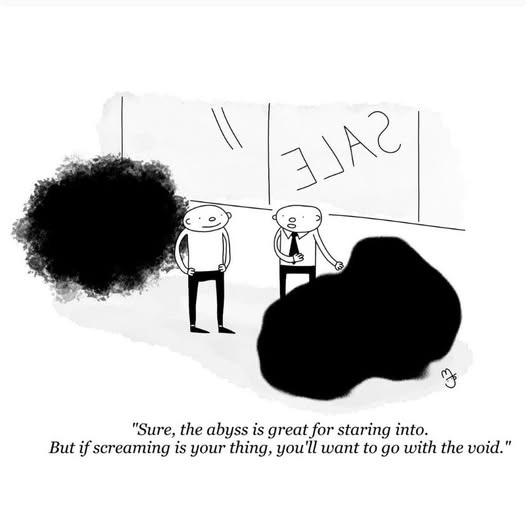
The second reaction is to deeply doubt the modern metaphysical doubt itself. You’ve felt the quiet, corrosive whisper beneath the modern howl. But what if the rebellion isn’t to double down on the bleakness (though with reckless joy), but to smash the skepticism? What if the true descent isn’t into the abyss, but upward into the possibility that the abyss is a lie? Consider the unthinkable. Doubt the doubt. Maybe God need not be dead, to you.
(Here, “God” is any supernatural being, power, or fundamental law—personal or impersonal, transcendent or immanent—that is the ground of reality, and toward which one may direct prayer, worship, or alignment. “Supernatural” means anything beyond the natural world and its laws yet exerting influence over it.)
Maybe God was just buried under bad arguments and intellectual cowardice and societal conformism. Maybe his probability isn’t Zero. It might even be uncomfortably high. Demote lazy atheism. Dial back that clock on the zeitgeist board. Use good and well-organized philosophy sites such as BeliefMap.org by Blake Giunta, or advanced yet accessible philosophy YT channels such as The Majesty of Reason by Joe Schmid, to see whether God is still quite possible.
Again, see my previous post.
The Goid

I composed the chief tenets here in a fit of existential anger. Why the heck is this so hard to settle, given it matters so much if it’s true?
So maybe bet on God, maybe even ask him for help, and go for your goal, together with your friends, even better. Maybe even see that goal as a way to become a small ‘g’ god and a friend of your human friends but of the real, capital ‘G’ God. Not just a vitalist overman but, god. Few say it, few suspect it, few know it, but, most importantly, you can still choose to be one of those who live it. Thus C.S. Lewis and others.
It is a serious thing to live in a society of possible gods and goddesses, to remember that the dullest and most uninteresting person you talk to may one day be a creature which, if you saw it now, you would be strongly tempted to worship, or else a horror and a corruption such as you now meet, if at all, only in a nightmare. All day long we are, in some degree, helping each other to one or other of these destinations.
— Lewis in “Weight of Glory” (1941)Mere morality is not the end of life. You were made for something quite different from that. J. S. Mill and Confucius (Socrates was much nearer the reality) simply didn’t know what life is about. The people who keep on asking if they can’t lead a decent life without Christ, don’t know what life is about; if they did they would know that ‘a decent life’ is mere machinery compared with the thing we men are really made for. Morality is indispensable: but the Divine Life, which gives itself to us and which calls us to be gods, intends for us something in which morality will be swallowed up. We are to be re-made. All the rabbit in us is to disappear - the worried, conscientious, ethical rabbit as well as the cowardly and sensual rabbit. We shall bleed and squeal as the handfuls of fur come out; and then, surprisingly, we shall find underneath it all a thing we have never yet imagined: a real Man, an ageless god, a son of God, strong, radiant, wise, beautiful, and drenched in joy. ... Morality is a mountain which we cannot climb by our own efforts; and if we could we should only perish in the ice and unbreathable air of the summit, lacking those wings with which the rest of the journey has to be accomplished. For it is from there that the real ascent begins. The ropes and axes are “done away” and the rest is a matter of flying.
— Lewis in “Man or Rabbit” (1946)I take it as axiomatic that one should settle for nothing less than the infinite mystery and the infinite delight ... In fact I demand it. I refuse to settle for anything less. I don’t see why anyone should settle for less …
— Catholic writer Walker Percy in his self-interview for Esquire (1977)
Settle for less? That’s still a surrender. That’s choosing the cage while the door hangs open. The gigachad future seduces with shiny distractions—android catgirls, cosmic vistas—but tells the lie, “This will satisfy.” Without deepness in your soul, you’ll yawn even over supernovas. The spiritually awake primitive has such deepness. Suppose he moves his finger. A simple act. Yet charged with magic. Because he sees it as his supernatural mind over matter. Maybe his wonder is ontological clarity, however oldskool. Maybe he perceives the is-ness radiating from all existence. (Compare Peter Kreeft, another Catholic, in his Everything You Ever Wanted to Know about Heaven, 1990, ch. 7.)
Let's insert some powerful sounds also here.
The choice, then, is this.
1) The Labyrinthian Bet. Hold your goal, find your brothers, descend into the dark to seize meaning with bloody fists.
2) The Divine Bet. Suspect the Void itself is an illusion. Face the possibility of God. Became cringe in this modern world by demanding his infinite delight. Let your goal become the path to becoming radiant beyond what the world can give. Brothers are helpful again, of course, regardless of whether they take God seriously.
How to make the choice?
Try this. It’s rather pragmatic, even Nietzschean, focused on what makes you stronger. Because I doubt you will find and grasp knock-down proofs.
First, ask yourself: Does the Void resonate as true? Or does the bleak reality feel brittle? Does a nagging suspicion whisper that the miasma itself might be a colossal, self- or society-inflicted delusion? Feel the pull. Note where it’s stronger. Maybe read Michael Huemer on intuiton.
Second, run a test. You don’t have to make a final, permanent choice. Treat both proposal as two hypotheses, and for each run a pragmatic personal experiment for a set period (e.g., 3 to 30 days). How?
Choose one concrete goal but not a chore, something that requires a joyous fight. E.g., “I am trying to invent a highly efficient desk-scale thermoelectric generator and I collaborate on it with close friends, because converting ambient heat into independent electricity reclaims our power and shatters corporate enslavement to centralized grids.” Much fun. Feel free to come up with something else, of course.
The goal does not change. The daily tasks—research, design, fabrication, testing, collaboration—do not change. What changes is the lens you apply. You can start with the perspective that’s less close to you.
Suppose it’s the Void mindset. Assume the world is a bleak panopticon. Interpret your struggles not as setbacks, but as friction that creates meaning. Seek an alliance of one or two people who understand and support you in the goal, even if they don’t share the entire worldview. Journal your experience. How it feels. Does the struggle feel energizing or just draining? Does this path feel like a coping mechanism?
When done, make a break, for at least a few days. Then try the God mindset. Challenge skepticism about him. Dedicate time to the resources mentioned (BeliefMap.org, Joe Schmid’s Majesty of Reason on YT). Engage with the arguments as if a probable answer is possible. Try spiritual practice. This could be a simple prayer (e.g., ask God for help during the day), simple meditation (e.g., try The Practice of the Presence of God by Brother Lawrence, or something else from Anthony de Mello’s Sadhana, 1978), or simply sitting in silence and asking, “Are you there?” with openness to a response. Journal again. Your intellectual and intuitive responses. Does the skepticism feel brittle or robust when challenged? Do you feel a sense of longing (like Percy or Lewis) or just intellectual curiosity? Does the world start to feel any different when viewed through this lens?
After the experimental period, compare the experiences. Ask, which one mindset seems more true or likely? Also, pragmatically, which one generated more life in you? Not comfort or ease, but rather vitality and purpose. And which one felt more sustainable?
Your answers might change in time, if you repeat the experiment once in a few months or years.
Moreover, you can consider a synthesis. Fierce will and focus can be the engine that drives the quest for infinite delight. Faith and hope can back up the will and focus. All is best done with good friends. In this synthesis, you don’t descend into the labyrinth to create your own meaning from scratch. The protodragon awakens to burn fiercely within the panopticon, even to burn his way out of it, toward a North Star he has reason to believe is real.
The choice is made by reasoning, as well as by taking a step. Choose an experiment and begin. As usual, the path will reveal itself by walking it.
This is just a very brief observation. Because I want to think about it, and I’m a connoisseur of ideas. Even a monkey could write a comment like: Nice, good, great!
Hmm. Passages I’m pondering.
"The world feels small and artificial, a malevolent panopticon observed by a demiurge feasting on despair. Even fleeting raw moments are reprieves in a bubble you can never leave."
"The problem for man as for other animal isn’t stress or suffering, but the feeling that one can’t escape…"
(My comment) I agree with this perception of time. In fact, the only time a person can truly realize they are alive is when they are bored. Why? Because that’s when a person focuses on every sensation.
(paraphrase)
As soon as a great power imposes its will...
comfort increases, and thus many are born who, from the moment of their birth, experience life in a state of exhaustion...
It is the very nature of domestic life that presents the world as a closed, private space, and although humanity as a whole adapts to this state—both biologically and culturally—even in the most ordinary people there remains a glimmer of the opposite tendency
(My comment) I totally agree. I’m going with this selective perspective :D
This has long been how I describe myself—my alter ego in music:
My music goes against the comfort that numbs.
"You feel the weight, that thick, suffocating despair, bleakness choking the horizon, skepticism poisoning every dream, loneliness of hollowed-out shared meaning. These objections pile up like corpses. Why even try?"
(My comment) For last very hanks—I had to work it out for myself—because I’m lazy and complacent, so I only did it in my head. Why bother trying at all? Why not just kill myself?
The answer lies in transcendence and faith, which I don’t believe is true in and of itself.
When I feel like continuing to read, I'll leave next comment.